
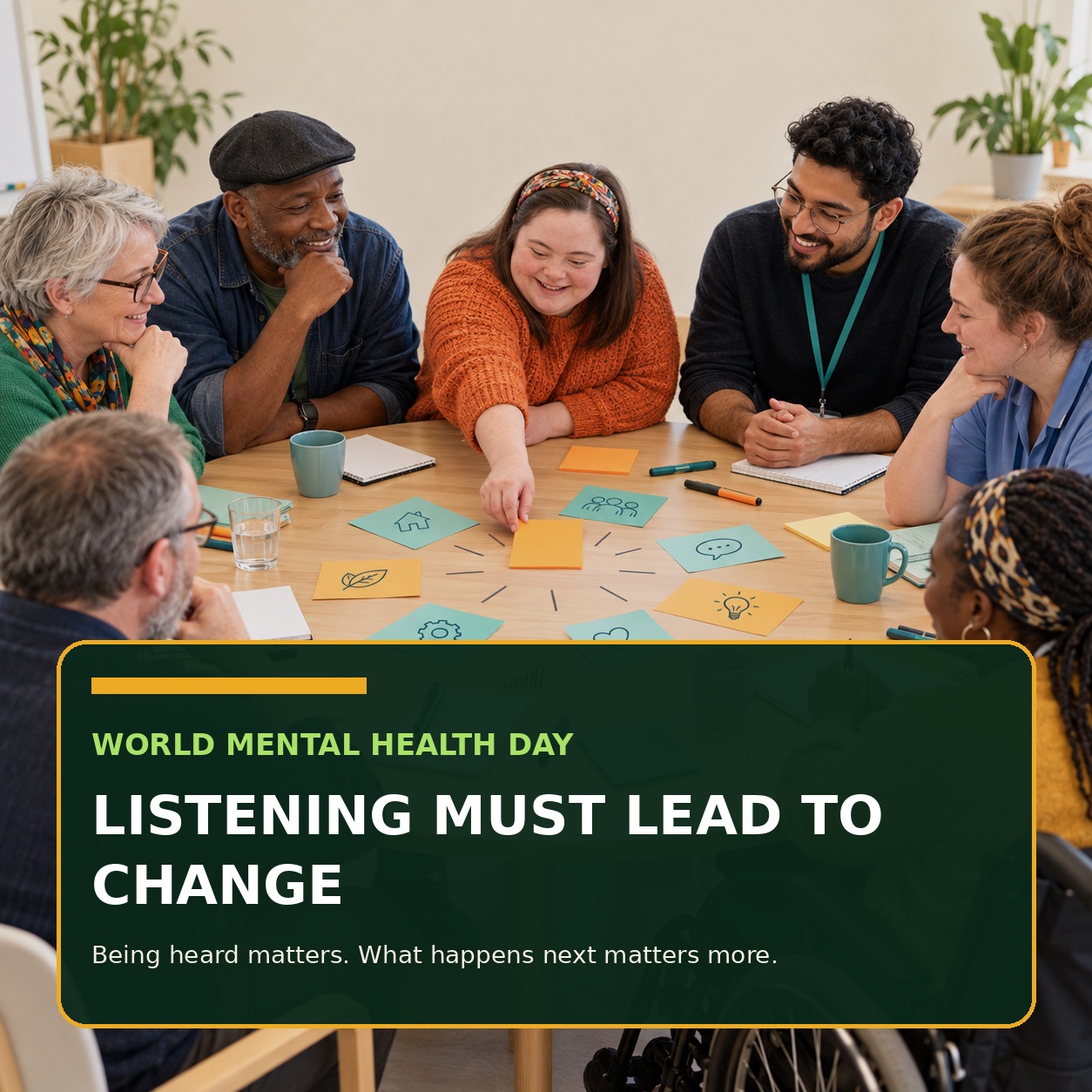
World Mental Health Day: Listening Must Lead to Change
Why lived experience should shape everyday care—not simply be collected as feedback
World Mental Health Day takes place on 10 October. The 2026 theme, “Lived experiences heard: real voices, real change”, asks services to go further than inviting people to tell their stories. It asks whether those experiences are genuinely influencing decisions, services and practice.
That distinction matters in adult social care.
People who receive care know things that policies, audits and training manuals cannot reveal on their own. They know how support feels at seven o’clock on a difficult morning. They notice when routines protect their confidence—and when apparently small decisions remove their control. Families and unpaid carers may also recognise patterns, triggers and strengths that are easily missed during a short assessment.
Listening is important. But if nothing changes afterwards, “having a voice” can become little more than a slogan.
BEING HEARD IS NOT THE SAME AS BEING CONSULTED
A questionnaire, residents’ meeting or care review may provide an opportunity to speak. That does not automatically mean the person has been heard.
Meaningful involvement requires staff and organisations to consider what has been communicated, explain what will happen next and show how it has influenced care. Sometimes a request can be acted upon immediately. Sometimes alternatives must be discussed because of safety, resources, other people’s rights or professional responsibilities. Even then, the person deserves an honest explanation—not silence.
Care Quality Commission Regulation 9 requires care and treatment to be appropriate, meet people’s needs and reflect their preferences. CQC guidance also says providers should make every reasonable effort to meet preferences and explain when they cannot be met. Listening is therefore not an optional courtesy. It is part of delivering person-centred care.
LISTENING IS MORE THAN HEARING WORDS
Not everyone communicates through speech, lengthy meetings or written feedback forms. A person may communicate through behaviour, facial expression, gesture, pictures, objects of reference, signing, assistive technology or changes in their usual presentation.
Good care asks:
- How does this person communicate agreement, uncertainty, distress or refusal?
- What helps them process information and express a choice?
- Are we allowing enough time?
- Is the environment making communication easier or harder?
- Should an advocate, interpreter, family member or trusted supporter be involved—with the person’s consent where appropriate?
Mental illness, learning disability, dementia or difficulty communicating must never be treated as automatic proof that somebody cannot make a decision. Capacity is decision-specific and time-specific. Staff should begin from the presumption that an adult has capacity and provide practicable support to help them decide before concluding otherwise.
WHAT DOES “REAL CHANGE” LOOK LIKE?
The most convincing evidence of listening is visible in everyday practice.
It might mean changing the time of personal care because mornings are associated with anxiety. It could mean recording how a person prefers staff to approach them, replacing an inaccessible complaints form, reducing noise in a communal area or arranging reviews at a time when somebody communicates most effectively.
At service level, lived experience might influence induction training, staffing arrangements, activity planning, environmental design, incident reviews or the language used in policies. Complaints, compliments, informal comments and patterns of refusal can all provide useful evidence when they are examined thoughtfully.
A simple action cycle can help:
- ASK – create an accessible and psychologically safe opportunity to contribute.
- LISTEN – give attention without becoming defensive or rushing to solve the issue.
- CHECK – reflect back what you understood and allow the person to correct it.
- ACT – agree what will change, who is responsible and when it will happen.
- REPORT BACK – tell the person what was done, or explain clearly why a request could not be followed.
- REVIEW – check whether the change produced the intended result.
Without the final three stages, feedback can disappear into a file while the person’s experience remains unchanged.
FROM PARTICIPATION TO CO-PRODUCTION
There are different levels of involvement. Services may inform people about a decision, consult them on proposed options, engage them in exploring a problem, co-design a solution or work in genuine co-production.
NHS England describes co-production as people who use services, carers and communities working in equal partnership from the earliest stages of design, development and evaluation. It recognises lived experience as expertise—not as a story added after the important decisions have already been made.
That does not mean every daily choice needs a committee. It means people affected by a service should have proportionate opportunities to shape it. If a provider redesigns its mental-health support, complaints process or staff training, people with relevant lived experience should be involved early enough to influence the result.
AVOIDING TOKENISM
Tokenism happens when somebody is invited to participate but has little real influence. Warning signs include:
- asking for feedback after the decision has effectively been made;
- relying on the same confident voices while excluding people who need communication support;
- requesting personal stories without explaining how they will be used;
- expecting people to contribute repeatedly without recognition, preparation or practical support;
- failing to report what changed;
- treating disagreement as a problem rather than useful evidence.
Services should actively seek a range of experiences. One person cannot represent everybody who shares a diagnosis, disability or type of service. Accessible formats, different meeting methods, independent advocacy and reasonable adjustments can help people participate on more equal terms.
THE ROLE OF FRONTLINE CARE STAFF
Frontline staff do not need to wait for a formal consultation exercise. Every interaction offers information about what matters to the person.
Care workers can:
- notice patterns and changes rather than dismissing them as “behaviour”;
- record the person’s own words and preferred communication method;
- distinguish between what the person said and the worker’s interpretation;
- raise recurring concerns through supervision, handovers and governance systems;
- check whether agreed actions actually happened;
- challenge routines that continue only because “we have always done it this way”; and
- share positive feedback so effective practice can be repeated.
Managers must then create routes through which those observations influence decisions. Staff cannot close the feedback loop if concerns repeatedly disappear above them.
LISTENING WELL DOES NOT MEAN PROMISING EVERYTHING
Person-centred practice is not the same as automatically agreeing to every request. Staff may need to balance rights, risks, consent, legal duties and the needs of other people. The important difference is whether the person is involved in that reasoning.
Shared decision making brings together professional knowledge and the person’s preferences, beliefs and values. Staff should explain options in an accessible way, discuss potential benefits and harms, and support the person to decide how involved they want to be. Where a preference cannot be met, the service should explain why and explore the least restrictive workable alternative.
A WORLD MENTAL HEALTH DAY COMMITMENT
World Mental Health Day gives services a useful reason to begin a conversation. Its value depends on what follows after 10 October.
A practical commitment could be to select one piece of recent feedback and trace its journey. Who heard it? Where was it recorded? Who considered it? What changed? Was the outcome reported back to the person? How will the service know whether the change helped?
The answers can reveal whether involvement is embedded in practice or ends at the listening stage.
People with lived experience are not simply recipients of care. Their knowledge can improve safety, dignity, communication and service quality. The task for care organisations is to build reliable ways for that knowledge to influence what happens next.
Being heard matters. What happens next matters more.
SOURCES AND FURTHER READING
World Health Organization – World Mental Health Day 2026
https://www.who.int/campaigns/world-mental-health-day/2026
Care Quality Commission – Regulation 9: Person-centred care
https://www.cqc.org.uk/guidance-regulation/providers/regulations-service-providers-and-managers/health-social-care-act/regulation-9
NHS England – Co-production
https://www.england.nhs.uk/always-events/co-production/
NICE – Shared decision making (NG197)
https://www.nice.org.uk/guidance/ng197