
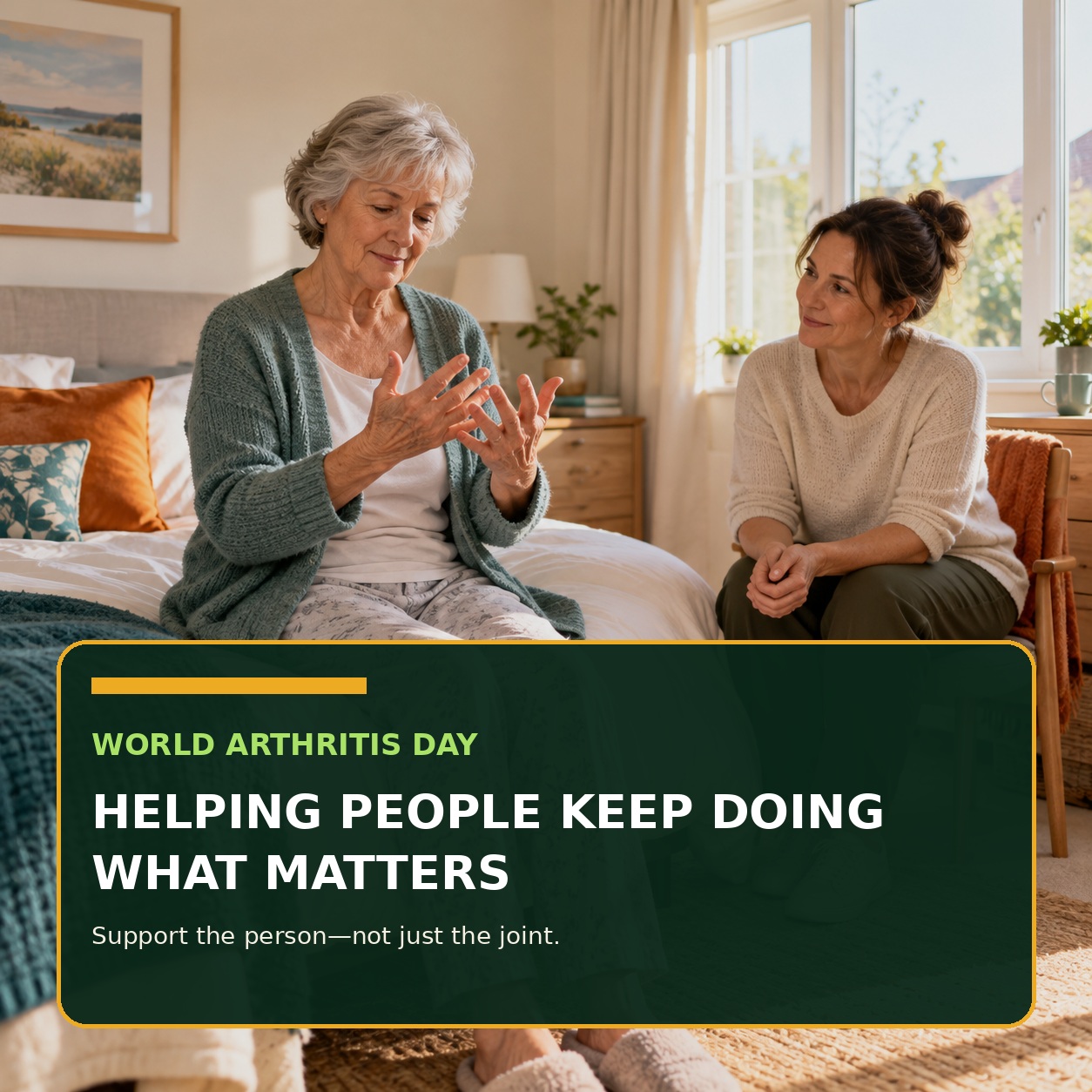
World Arthritis Day: Helping People Keep Doing What Matters
How care staff can recognise hidden symptoms, protect independence and support meaningful goals
World Arthritis Day takes place on 12 October. The 2026 campaign theme, “Achieve Your Dreams”, focuses on the ambitions and everyday goals of people living with rheumatic and musculoskeletal diseases.
For somebody receiving care, that dream may not sound dramatic. It might be fastening their own shirt, walking to the garden, preparing a favourite drink or continuing a hobby. Arthritis can make these activities slower, tiring or painful—but good support can help preserve them.
The task is not simply to care for a painful joint. It is to understand what the person wants that joint to help them do.
ARTHRITIS IS MORE THAN “WEAR AND TEAR”
Arthritis is a broad term covering conditions that cause joint pain, swelling and stiffness. Osteoarthritis and rheumatoid arthritis are among the best known, but they have different causes and treatment needs. Care workers should not diagnose the type of arthritis or assume that every new symptom is part of an existing condition.
Symptoms can vary from day to day. A person who managed an activity yesterday may struggle today because of a flare, poor sleep, fatigue or increased pain. This variability is real; it is not evidence that the person is being inconsistent or uncooperative.
Arthritis may affect:
- grip and fine hand movements;
- standing, walking and transfers;
- dressing, washing and preparing food;
- sleep and concentration;
- mood and confidence;
- energy levels; and
- participation in hobbies and social life.
Fatigue can be especially easy to miss. It may be experienced as profound physical and mental exhaustion rather than ordinary tiredness. Somebody may complete personal care but then have too little energy for the activity that gives their day meaning.
START WITH WHAT MATTERS TO THE PERSON
The 2026 World Arthritis Day theme offers a useful care-planning question: “What would you like to keep doing?”
That question changes the conversation. Instead of listing only deficits—cannot bend, cannot grip, needs help—the plan can identify the outcome the person values and what might make it achievable.
For example:
- “I want to choose and put on my own clothes.”
- “I want enough energy to attend the afternoon music group.”
- “I want to keep tending my plants.”
- “I want to walk to the dining room rather than always using the wheelchair.”
These goals should be realistic, reviewed and agreed with the person and relevant professionals. They should never be imposed as a test of motivation.
SUPPORT WITHOUT TAKING OVER
When somebody is in discomfort or moving slowly, doing the task for them can appear kind and efficient. Repeatedly taking over, however, may reduce movement, confidence, skills and control.
Enabling support means providing the least assistance needed for the person to participate safely. That might involve:
- allowing more time and avoiding unnecessary rushing;
- asking which part of the task they want help with;
- positioning items within easier reach;
- using equipment recommended for the individual;
- supporting the person to sit for a tiring task;
- breaking an activity into manageable stages; or
- arranging personal care for a time when stiffness is usually less severe.
The approach should be recorded in the care plan so that support is consistent. Equipment should not be introduced casually: an occupational therapist or other appropriate professional can assess the task and recommend suitable aids or adaptations.
PACE—DON’T SIMPLY STOP
Pain can lead people to avoid activity. Yet prolonged inactivity can contribute to weakness, stiffness and further loss of function. NICE identifies tailored therapeutic exercise as a core treatment for osteoarthritis, alongside information and support and weight management where appropriate.
Care staff should not invent exercise programmes. Their role is to encourage and support activities or exercises already agreed with the person and relevant clinician, physiotherapist or occupational therapist.
Pacing helps avoid the “boom-and-bust” pattern in which somebody does too much on a better day and then cannot function the next. Useful strategies include:
- planning demanding and lighter tasks across the day;
- taking breaks before exhaustion becomes severe;
- changing position rather than remaining still for long periods;
- prioritising activities that matter most to the person; and
- adapting a hobby instead of abandoning it.
Rest should make valued activity more sustainable, not replace it altogether.
NOTICE WHAT HAS CHANGED
Care workers often see the small functional changes that reveal a bigger problem. The person may take longer to stand, stop wearing clothes with buttons, leave meals unfinished because cutlery is difficult to grip, decline an activity or begin asking for assistance they did not previously need.
Useful recording is specific and objective. Compare:
“Mobility poor today.”
with:
“Mary required two pauses and support from the chair arms before standing. She said her right knee was more painful than usual and declined the garden walk she normally attends.”
Record:
- what the person said, using their own words where possible;
- the location and nature of pain or stiffness they describe;
- swelling, heat or visible change;
- the effect on sleep, mood, appetite, mobility and daily activities;
- what support was offered and whether it helped; and
- who was informed and what follow-up was agreed.
Care staff should follow the person’s care plan and local escalation procedures. They should not increase, omit or recommend medicines outside their role.
WHEN DOES JOINT PAIN NEED REVIEW?
Not every difficult day is an emergency, but new or worsening symptoms should not automatically be labelled “their arthritis”.
NHS advice recommends medical review when unexplained joint pain, swelling or stiffness does not improve within a few days. Joint pain that disrupts normal activity or sleep, gets worse, keeps returning or has not improved after self-care also warrants attention.
Urgent advice should be sought through the person’s agreed pathway, an urgent GP appointment or NHS 111 when there is severe pain and swelling in one joint that began suddenly, or when a joint is hot or red. Joint pain accompanied by fever, feeling hot, cold or shivery, or being generally unwell may indicate infection and requires urgent assessment.
Staff should also escalate a fall, injury, sudden inability to bear weight, acute loss of function or any other change covered by the organisation’s emergency procedures.
Remember that redness can be less visible on brown and black skin. Compare with surrounding skin and consider heat, swelling, tenderness and the person’s account rather than relying on colour alone.
PAIN IS PERSONAL
Behaviour does not provide a simple measure of pain. Some people grimace or guard a joint; others become quiet, irritable, withdrawn or reluctant to move. A person may smile and still be in significant pain.
Ask rather than assume. Use the person’s preferred communication method and any pain-assessment approach specified in their care plan. Where somebody has difficulty communicating, knowing their usual presentation is crucial—but observation should support their voice, not replace it.
Pain scores can be useful when applied consistently, but function may communicate just as much. “What is the pain stopping you from doing today?” can produce information that a number alone does not.
PROTECTING DIGNITY, CHOICE AND SAFETY
Arthritis support should remain person-centred. The person has the right to make choices, including choices that staff would not make for themselves, provided they have capacity for the specific decision. Risk management should explore how an activity can be made safer rather than automatically removing it.
Care teams can ask:
- What matters to this person?
- What part can they still do independently?
- What small adjustment would help?
- Are we following professional advice and the care plan?
- Has anything changed that needs recording or escalation?
A WORLD ARTHRITIS DAY COMMITMENT
For World Arthritis Day, choose one person whose participation has gradually reduced. Review a meaningful activity with them. Are pain, stiffness, fatigue, timing, the environment or the way support is delivered creating avoidable barriers?
The answer may be more time in the morning, a reviewed pain-management plan, an occupational-therapy assessment, a seated version of a hobby or simply staff remembering to ask before taking over.
Success is not measured only by how quickly a task is completed. It is also measured by whether the person remains involved in their own life.
Support the person—not just the joint.
SOURCES AND FURTHER READING
EULAR – World Arthritis Day 2026
https://www.eular.org/world-arthritis-day-2026
NHS – Arthritis
https://www.nhs.uk/conditions/arthritis/
NICE – Osteoarthritis in over 16s: diagnosis and management (NG226)
https://www.nice.org.uk/guidance/ng226
Versus Arthritis – Joint care
https://www.versusarthritis.org/about-arthritis/managing-symptoms/joint-care/