
When online health advice enters the care plan: responding safely to misinformation
Online health information can help people understand conditions, prepare questions and participate more fully in decisions about their care. It can also be inaccurate, misleading or dangerous.
The difference is not simply whether advice appears online. NHS information, professional guidance and regulatory decisions are also published online. The important questions are who produced the information, what evidence supports it, whether the person is working within their competence and what could happen if somebody acts upon the claim.
This matters in adult social care because an online video can quickly influence real decisions: whether somebody takes a prescribed medicine, accepts antibiotics, attends an appointment or seeks urgent assessment.
WHY THIS SUBJECT IS IN THE NEWS
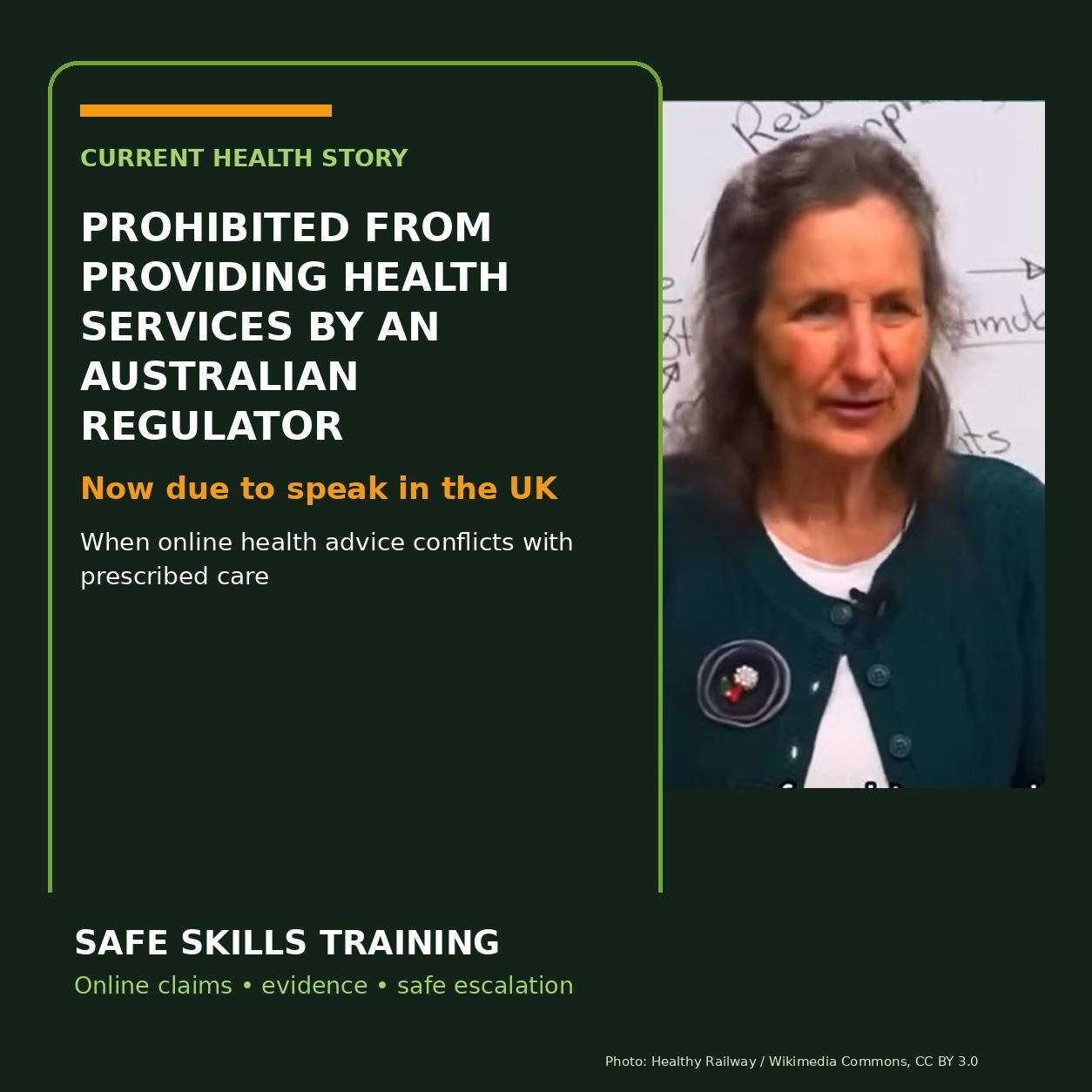
Current UK reporting has focused on Barbara O’Neill, an Australian speaker who promotes “natural self-healing” and is due to appear at events in the UK and Ireland.
In 2019, the New South Wales Health Care Complaints Commission investigated claims she had made concerning cancer, antibiotics, vaccination and infant nutrition. The regulator concluded that she posed a risk to public health and safety and issued a permanent order prohibiting her from providing health services.
The issue is not whether people may discuss diet, wellbeing or complementary approaches. Nor should care staff ridicule somebody because they find a speaker persuasive. The patient-safety concern begins when unsupported claims encourage someone to stop effective treatment, reject necessary assessment, use potentially harmful products or delay seeking help.
WHY SHOULD ANYONE TRUST SAFE SKILLS?
Safe Skills Training is also an online source offering information to care staff. We should therefore be judged by the same standard.
Do not accept a claim merely because it carries our logo. Check whether we:
- identify the guidance or evidence supporting important statements
- distinguish established guidance from professional interpretation or opinion
- stay within our professional scope and competence
- acknowledge uncertainty and limitations
- correct errors transparently
- direct people towards qualified assessment when individual clinical decisions are needed
Reliable education should help people examine evidence—not ask them to replace one unquestioning authority with another.
POPULARITY IS NOT CLINICAL EVIDENCE
A large following, professional-looking video, confident delivery or collection of personal testimonials does not establish that health advice is safe or effective.
Testimonials may be sincerely reported, but they cannot show what would have happened without the intervention, exclude other causes of improvement or reliably identify uncommon harms. Repetition also creates familiarity: a claim may feel more believable simply because it appears frequently.
Useful checks include:
- Who produced the information?
- What relevant qualifications and professional registration do they hold?
- Are they advising within that professional scope?
- Is the claim supported by current, identifiable evidence or guidance?
- Do they acknowledge risks, limitations and alternatives?
- Are they selling a product, retreat, subscription or treatment?
- Does the advice suggest stopping prescribed care or avoiding qualified professionals?
- Can the claim be checked against NHS, NICE, MHRA or recognised professional guidance?
A conflict of interest does not automatically make a claim false. It does mean the claim deserves careful scrutiny.
WHEN A PERSON SHARES ONLINE HEALTH ADVICE
Begin with curiosity rather than confrontation. A dismissive response may make the person less willing to explain what they intend to do.
Ask:
- What did you see or hear?
- What did the source recommend?
- What are you considering changing?
- Have you already stopped, reduced or added anything?
- What benefit are you hoping for?
- Is anything worrying you about your current treatment?
These questions identify the actual risk. Watching a video is different from stopping insulin, declining antibiotics or taking an unregulated product alongside prescribed medicines.
DO NOT OFFER A COUNTER-DIAGNOSIS
Care staff should not attempt to settle a complex medical argument themselves. They should identify the concern, use reliable information within their role and involve an appropriate professional.
Depending on the issue, that may be:
- the person’s GP or prescriber
- a community or specialist nurse
- the supplying pharmacist
- NHS 111
- emergency services
- the service’s safeguarding or management lead
Do not independently stop, withhold, reduce, crush or alter a prescribed medicine because an online source recommends doing so. Follow the prescription, care plan, authorised protocol and organisational medicines policy.
IF THE PERSON REFUSES A MEDICINE OR TREATMENT
Adults must be presumed to have capacity unless there is evidence otherwise. A person with capacity may make a decision that other people regard as unwise.
That does not mean staff should ignore the situation. They should:
- provide information in an accessible way
- check what the person understands and whether communication needs have been met
- avoid pressure, ridicule or coercion
- respect a valid capacitous refusal
- record the circumstances and the person’s stated reason
- follow the agreed refusal process and care plan
- inform the appropriate clinician when required
- monitor for deterioration and follow escalation instructions
Capacity is specific to the particular decision and the time it must be made. If there is a genuine concern about capacity, arrange assessment by the appropriate person in accordance with the Mental Capacity Act, the care plan and organisational policy. Disagreement with professionals does not, by itself, demonstrate lack of capacity.
NICE advises care-home staff to record the circumstances and reasons for medicine refusal where the person will provide them, and to involve the prescriber and supplying pharmacy in ongoing refusal where appropriate and with the person’s agreement. CQC guidance also requires accurate, current medicines records, including refused doses.
WHEN THE RISK IS URGENT
Do not allow a debate about online information to delay emergency care.
Call 999 for life-threatening symptoms, including severe breathing difficulty, collapse, unconsciousness, signs of stroke, suspected anaphylaxis or other immediately dangerous deterioration.
For urgent concerns that are not immediately life-threatening, follow the person’s care plan, local clinical pathways and NHS 111 arrangements where appropriate.
If prescribed time-critical treatment has been omitted or stopped, seek prompt clinical advice in accordance with the care plan and medicines policy. The degree of urgency depends upon the medicine, condition, missed doses and the person’s current health; staff should not guess.
CONSIDER SAFEGUARDING AND FINANCIAL EXPLOITATION
Some misinformation is linked to costly products, private programmes or pressure to disengage from family and established care.
Consider safeguarding procedures where there are concerns about:
- coercion or undue influence
- substantial or repeated payments
- somebody controlling the person’s communication or purchases
- products being given without informed consent
- deliberate interference with essential treatment
- targeting connected to cognitive impairment, distress or vulnerability
Do not label every unconventional health choice as abuse. Record the facts and seek advice through the appropriate safeguarding route.
STAFF MUST KEEP PERSONAL BELIEFS SEPARATE
Care workers may hold personal beliefs about diet, vaccination, medicines or complementary therapies. They must not use their position to promote those beliefs, recommend unapproved products or discourage prescribed treatment.
Professional boundaries require staff to give support consistent with the person’s care plan, consent, current guidance and their own training and competence.
DOCUMENT WHAT MATTERS
Useful documentation should include:
- the specific claim or advice discussed
- where the information came from, if known
- what the person proposes to start, stop or change
- medicines or treatment already missed or altered
- the person’s understanding, wishes and stated reasons
- information or support provided by staff
- symptoms, observations or changes from baseline
- who was contacted, when and what information was shared
- advice received, actions agreed and the review timescale
- what staff should do if the person deteriorates or changes their mind
Avoid vague entries such as “internet advice discussed” or “GP informed”. Record enough detail for the next member of staff to understand the risk and follow the plan.
USING SBARD TO ESCALATE
SBARD can help staff present the concern clearly:
Situation — State what the person intends to change and the immediate concern.
Background — Give relevant diagnoses, medicines, recent treatment and normal baseline.
Assessment — Describe what has already changed, any missed treatment, symptoms, observations and the person’s understanding.
Recommendation — Request the appropriate clinical advice, review or urgent response.
Decision — Record what was agreed, who will act, the timescale and the deterioration plan.
The structure should support communication, not delay an urgent call.
THE PRACTICAL MESSAGE
Online information is not automatically unsafe, and official information is not automatically understood correctly. The professional response is neither blind acceptance nor blanket dismissal.
Pause. Establish what may change. Check the source and evidence. Support informed decision-making. Record accurately. Escalate clinical or safeguarding risks through the correct route.
Above all, apply the same scrutiny to every source—including Safe Skills Training.
Safe Skills Training provides practical clinical-skills, first-aid and patient-safety training for adult social-care teams. To discuss training for your organisation, visit www.safeskillstraining.com.
GUIDANCE AND SOURCES
NSW Health Care Complaints Commission: Permanent prohibition order
https://www.hccc.nsw.gov.au/decisions-orders/prohibition-orders/ms-barbara-oneill-permanent-prohibition-order
NSW Health Care Complaints Commission: Investigation findings and media release
https://www.hccc.nsw.gov.au/decisions-orders/media-releases/2019/mrs-barbara-o-neill-breaches-of-code-of-conduct-permanent-prohibition-order
The Guardian: “Self-healing” coach banned from working in Australia to speak in UK
https://www.theguardian.com/society/2026/oct/02/natural-wellness-coach-banned-australia-uk-lectures
NICE: Managing medicines in care homes (SC1)
https://www.nice.org.uk/guidance/sc1/chapter/recommendations
NICE: Managing medicines for adults receiving social care in the community (NG67)
https://www.nice.org.uk/guidance/ng67/chapter/recommendations
CQC: Medicines administration records in adult social care
https://www.cqc.org.uk/guidance-providers/adult-social-care/medicines-administration-records-adult-social-care
GOV.UK: Mental Capacity Act Code of Practice
https://www.gov.uk/government/publications/mental-capacity-act-code-of-practice
NHS: Medicines A to Z
https://www.nhs.uk/medicines/
IMAGE CREDIT
Barbara O’Neill photograph: Healthy Railway – Barbara O’Neill & More, via Wikimedia Commons. Licensed CC BY 3.0. Cropped and overlaid with text.
https://commons.wikimedia.org/wiki/File:Barbara_O%27Neill_in_2024,_at_29_13.jpg
