
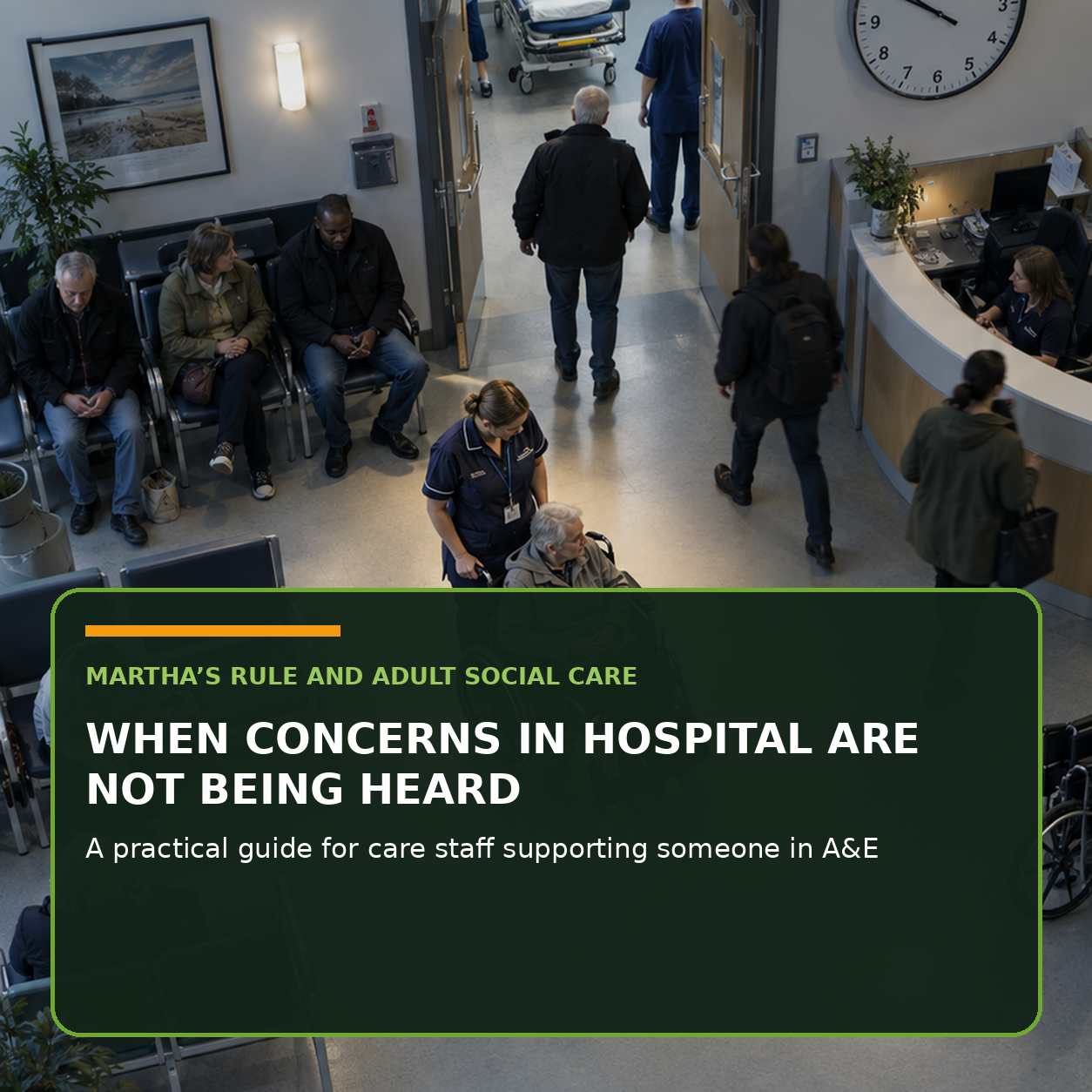
When concerns in hospital are not being heard: understanding Martha’s Rule
When a care worker accompanies somebody to hospital, they may be the person in the room who best understands what “normal” looks like for that individual.
They may know that the person is usually talkative but has become unusually quiet. They may notice that familiar confusion has suddenly worsened, that the person is much harder to wake, or that their breathing, colour, movement or behaviour has changed.
That knowledge is clinically important. A set of observations provides valuable information, but it does not replace the insight of somebody who knows the person’s usual presentation.
Martha’s Rule gives patients, families and carers a formal route to request a rapid review when they are worried that a hospital patient is deteriorating and their concerns do not appear to be receiving an appropriate response.
The NHS announced in September 2026 that Martha’s Rule will be extended into A&E departments across England. This is a phased rollout due to be completed by March 2028, so care staff must not assume that the same process is already available in every emergency department.
WHAT IS MARTHA’S RULE?
Martha’s Rule is a patient-safety initiative designed to help identify physical deterioration and make sure concerns from patients, families, carers and staff are heard.
Where it is operating, the hospital provides a dedicated 24-hour route through which a rapid clinical review can be requested. The review should be carried out by a team that is different from the team currently responsible for the person’s care.
It is intended for situations in which:
- the person appears to be getting worse
- the patient, family member or carer is seriously worried
- the concern has already been raised with the clinical team
- the person raising the concern does not feel that the deterioration is being recognised or addressed
It is not a general complaints service, a way to move somebody up a waiting list, or a replacement for speaking directly with the nurses and doctors caring for the person.
WHY THIS MATTERS IN ADULT SOCIAL CARE
Hospital staff may be meeting the person for the first time. A care worker may know:
- their usual level of alertness and orientation
- how they normally communicate pain or distress
- their usual breathing, mobility, appetite and continence
- how dementia, a learning disability or another condition normally affects them
- whether unusual behaviour is a recognised response or a new warning sign
- what their observations were before transfer
- which medicines have been administered, omitted or recently changed
- whether there has been a recent fall, infection, procedure or change in health
Phrases such as “they seem all right for their age” or “they are confused because they have dementia” can conceal a significant change. The useful question is not simply whether the person appears unwell. It is: how are they different from their normal baseline?
FIRST: RAISE THE CONCERN DIRECTLY
If somebody appears to be deteriorating, tell the nurse or doctor responsible for their care immediately. Do not wait for the next routine observation round.
Be direct:
“I am worried that this person is deteriorating.”
Then explain the change:
- what you have noticed
- when it began
- whether it is continuing or worsening
- how this differs from the person’s normal presentation
- any observations or trends available
- what has already been reported and what response followed
Ask what assessment will take place and what you should do if the person worsens further.
MAKE THE CHANGE CLEAR WITH RESTORE2
If your service uses RESTORE2, take the completed documentation to hospital or make sure the relevant information accompanies the person.
RESTORE2 combines soft signs, changes from baseline and physiological observations. Soft signs may include the person:
- behaving differently
- becoming unusually sleepy, confused or agitated
- eating or drinking less
- passing less urine
- becoming less mobile
- looking unusually pale, flushed or clammy
- reporting new or increasing pain
- appearing generally “not right”
If staff are trained and authorised to record observations, provide the results and any trend rather than offering a single number without context. Explain what action was triggered under the service’s local escalation policy.
RESTORE2 supports recognition and communication. It does not diagnose the cause of deterioration and must never delay urgent help.
USE SBARD TO ESCALATE CONCISELY
SBARD can help staff organise information when a busy clinical team needs a clear account:
Situation — Identify the person and state the immediate concern: “I am worried that they are deteriorating.”
Background — Give the relevant diagnosis, normal baseline, recent illness or injury, medicines, allergies and reason for hospital attendance.
Assessment — Describe what has changed, when it changed, current soft signs, observations and trends, and anything the person has reported.
Recommendation — State what you need: prompt reassessment, senior review or another specific action.
Decision — Record what was agreed, who is responsible, the timescale and what should happen if the person worsens.
SBARD should make the concern easier to understand. It should not turn a genuine deterioration concern into a passive exchange of information.
IF YOU STILL FEEL THE CONCERN IS NOT BEING HEARD
Ask the hospital whether Martha’s Rule is available in that ward or A&E department and how it is accessed locally.
Hospitals using Martha’s Rule should display information explaining their process and dedicated contact number. There is not one universal telephone number for every hospital.
When requesting a rapid review, be prepared to explain:
- who the person is and where they are
- what has changed
- why the change concerns you
- when and to whom it has already been reported
- what response has been received
- why you believe further review is required
If the local A&E has not yet introduced Martha’s Rule, continue escalating through the nurse in charge, senior clinician or hospital patient-safety route. Ask who can review the person now. Do not allow the absence of a named scheme to end the escalation.
MARTHA’S RULE DOES NOT REPLACE EMERGENCY ACTION
Outside hospital, call 999 for a life-threatening emergency. Do not try to contact a hospital Martha’s Rule number instead.
Inside hospital, alert staff immediately if the person becomes unresponsive, has severe breathing difficulty, develops signs of a stroke, has a seizure, collapses or deteriorates suddenly. Use the emergency call system available in that area.
Martha’s Rule is an additional safety route when a deterioration concern is not being heard. It is not a reason to delay immediate emergency assistance.
SUPPORT THE PERSON’S OWN VOICE
Whenever possible, help the person explain what feels different and what matters to them. Provide communication aids, glasses, hearing aids or information from their communication passport.
Do not speak over somebody who can express their own concerns. Equally, do not assume that a person who communicates differently has nothing useful to contribute.
If the person lacks capacity for a particular decision, staff must still involve them as far as possible and ensure that relevant representatives and hospital staff have the information needed to make lawful, person-centred decisions.
DOCUMENT THE ESCALATION
Record:
- the change from baseline and the time it was noticed
- observations, soft signs and the person’s own words
- who was informed and at what time
- what information was given
- the advice, assessment or review provided
- whether Martha’s Rule or another escalation route was used
- the agreed plan, monitoring and follow-up
Documentation should support continuity and accountability, but writing the record must not delay urgent action.
THE PRACTICAL MESSAGE
Care workers are not expected to diagnose deterioration in hospital. They are expected to recognise when something has changed, communicate that change clearly and continue escalating when they remain seriously concerned.
Knowing the person is not “just background information”. It may be the information that makes deterioration visible.
Safe Skills Training provides practical clinical-skills, first-aid and patient-safety training for adult social-care teams. To discuss training for your service, visit www.safeskillstraining.com.
GUIDANCE AND FURTHER INFORMATION
NHS England: Martha’s Rule
https://www.england.nhs.uk/patient-safety/marthas-rule/
NHS England: Information for patients, families and carers
https://www.england.nhs.uk/patient-safety/marthas-rule/information-patients-families-carers/
NHS England: Managing acute physical deterioration through the PIER approach
https://www.england.nhs.uk/patient-safety/managing-acute-physical-deterioration-through-the-prevention-identification-escalation-response-pier-approach/
NHS Hampshire and Isle of Wight: RESTORE2 resources
https://www.hantsiow.icb.nhs.uk/your-health/schemes-and-projects/restore2