
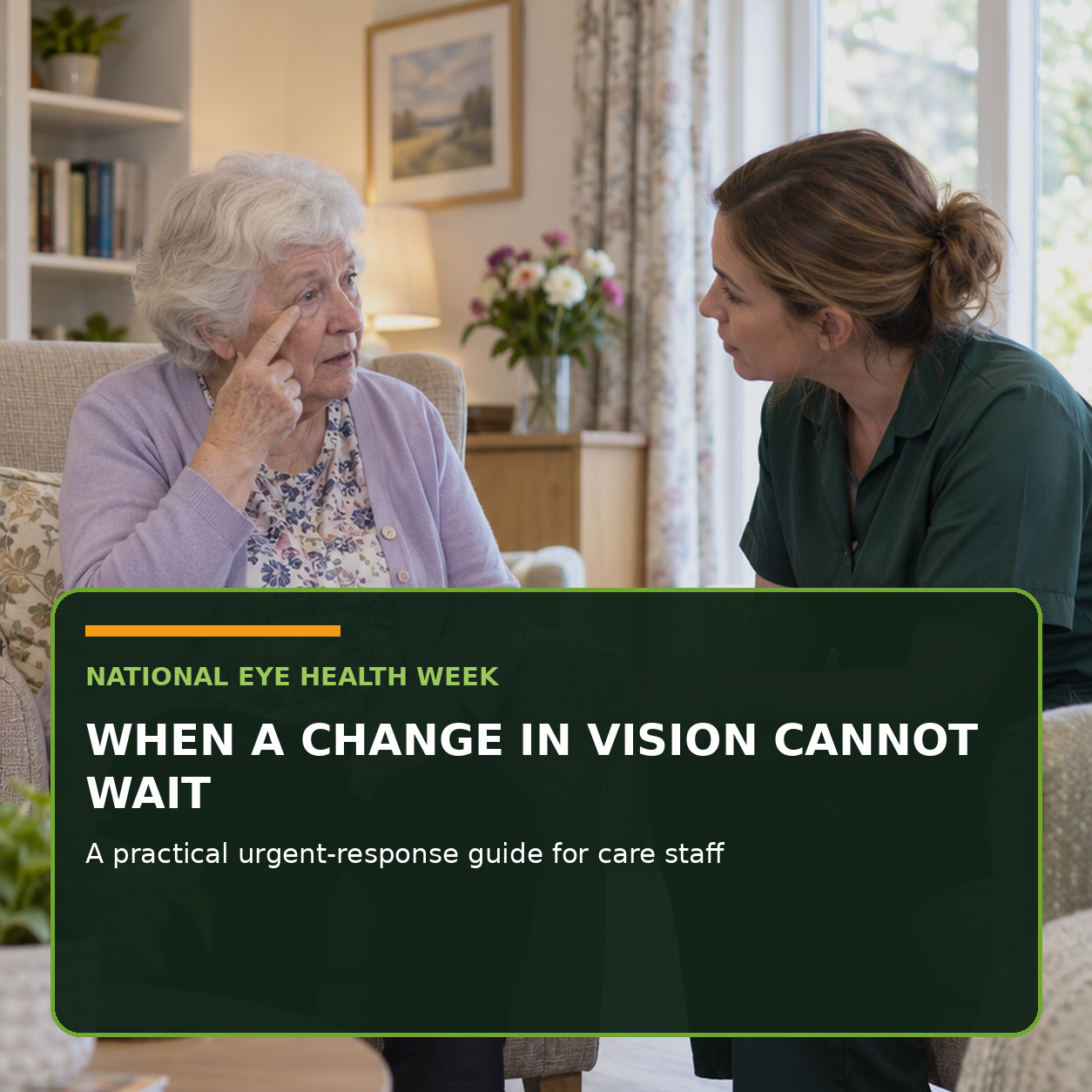
When a change in vision cannot wait
National Eye Health Week runs from 21 to 27 September 2026. It promotes regular eye tests and better awareness of changes that may threaten sight.
For adult social-care staff, eye health is not only about making sure somebody wears the correct glasses. A sudden change in vision may need urgent assessment, and some symptoms require emergency action.
The person may not use clinical language. They may describe “flies”, “cobwebs”, “sparks”, “a shadow”, “a curtain”, “mist” or part of the room disappearing. Those words matter. Record what the person actually reports rather than translating it into a diagnosis.
Staff are not expected to diagnose an eye condition. They do need to recognise that a new visual symptom can be time-critical, gather useful information and follow the correct escalation route.
WHY SUDDEN CHANGES MATTER
Some long-standing floaters are harmless. However, a sudden appearance or increase in flashes or floaters, a dark curtain or shadow, or sudden blurred vision can be associated with a retinal tear or retinal detachment.
The retina is the light-sensitive layer at the back of the eye. A detached retina needs to be treated quickly to reduce the risk of permanent sight loss.
Warning signs can include:
- new flashes of light
- floaters appearing for the first time
- a sudden shower or increase in floaters
- a dark curtain or shadow moving across the vision
- sudden blurring or another change in eyesight
- symptoms beginning after an eye injury or eye surgery
The person does not need to have every symptom. Retinal detachment can also be painless, so the absence of pain must not be used as reassurance.
ASK FOCUSED QUESTIONS
If somebody reports a visual change, first make sure they are safe. Help them sit down if needed and reduce immediate risks from stairs, traffic, hot drinks, obstacles or walking without support.
Ask:
- What can you see now?
- Is one eye affected or both?
- Did the change begin suddenly or gradually?
- What time did it begin, or when were they last able to see normally?
- Are there flashes, floaters, a shadow, curtain, blur or complete loss of vision?
- Is the eye painful, red or sensitive to light?
- Is there a severe headache, nausea or vomiting?
- Has there been a recent fall, blow, foreign body or chemical splash?
- Has the person recently had eye surgery or treatment?
- Are there any stroke signs, such as facial weakness, arm weakness or speech difficulty?
Do not delay escalation while trying to obtain a perfect history. If the person suddenly cannot see, has severe eye pain, has sustained a serious eye injury or may be having a stroke, act immediately.
USE THE PERSON’S COMMUNICATION METHOD
A person with dementia, a learning disability, aphasia or another communication need may find visual symptoms difficult to describe.
Useful approaches may include:
- asking one short question at a time
- checking each eye separately only if the person can comfortably cooperate
- using familiar objects and asking what looks different
- offering simple choices without suggesting the answer
- using pictures, signs, gestures or the person’s communication aid
- checking the communication passport or care plan
- involving somebody who knows the person’s usual vision and communication
Observe functional changes too. The person may suddenly reach inaccurately, collide with objects on one side, miss food on part of the plate, become reluctant to walk, or appear frightened in a familiar environment.
These observations are not a diagnosis, but they can help a clinician understand the change.
WHEN TO SEEK URGENT HELP
The NHS advises seeking an urgent optician appointment or help from NHS 111 for:
- floaters or flashes appearing for the first time
- sudden new floaters or flashes
- a sudden increase in their number
- a dark curtain or shadow across the vision
- blurred vision alongside floaters or flashes
- eye pain with these symptoms
- floaters or flashes beginning after eye surgery or an eye injury
Follow local urgent-eye-care pathways where these are available. The service’s care plan or policy should explain who staff contact and how transport and support will be arranged.
Do not book a routine appointment several days away for a sudden warning sign, and do not wait until the next shift to see whether it improves.
WHEN IT IS AN EMERGENCY
The NHS advises going to Accident and Emergency or calling 999 if a person:
- suddenly cannot see from one or both eyes
- suddenly develops severe eye pain
- has a red eye with loss or another change of vision
- has a serious eye injury or something has pierced the eye
- has a dangerous chemical in the eye
- has visual change with signs suggesting a stroke
Do not allow the person to drive. Follow the emergency operator’s instructions and take an up-to-date medicines list and relevant care information when possible.
If stroke is suspected, use FAST: Face weakness, Arm weakness, Speech difficulty—Time to call 999. Sudden visual loss or blurring can also occur with a stroke, so tell the call handler exactly what changed and when it began.
CHEMICALS IN THE EYE
A chemical eye injury needs immediate action. Call 999 and begin irrigation without waiting for transport.
The NHS advises:
- use plenty of clean water that is not hot
- hold the eye open if possible
- run water gently over the eyeball for at least 20 minutes
- keep rinsing while waiting for medical help when a strong chemical is involved
- take the product container or safety information to hospital when this can be done safely
Do not put creams, drops or another chemical into the eye unless emergency or clinical professionals instruct you to do so. Do not try to remove an object that has pierced the eye.
RECORD AND ESCALATE WITH SBARD
Clear documentation can protect sight by helping the next clinician understand the urgency.
Record:
- the person’s exact description
- which eye appears affected
- the onset time or last-known-normal time
- whether the change was sudden or gradual
- associated pain, redness, headache, nausea or neurological signs
- any recent injury, chemical exposure, surgery or treatment
- observations and first aid provided
- who was contacted, when and what was advised
- transport, monitoring and follow-up arrangements
SBARD can structure the escalation:
Situation — Who are you concerned about, and what sudden visual change has occurred?
Background — Include known eye conditions, diabetes, recent surgery or treatment, injury, medicines and relevant health history.
Assessment — Describe the person’s exact words, which eye is affected, onset time, pain, redness, associated symptoms and any observations or stroke signs.
Recommendation — State the assessment or emergency response needed.
Decision — Record the agreed action, who will arrange it, timescales, transport and what to do if symptoms worsen.
SBARD supports communication. It must never delay calling 999 when emergency signs are present.
ROUTINE EYE HEALTH STILL MATTERS
Not every eye problem is an emergency, but routine care helps prevent avoidable sight loss.
Care plans should reflect whether the person:
- has the correct glasses, labelled where necessary and available when needed
- needs support to clean, store or put on glasses
- has attended routine sight tests at the interval advised by their optometrist
- receives diabetic eye screening when invited
- uses prescribed eye drops correctly
- has changes in mobility, reading, eating or daily activities that could indicate worsening vision
- needs environmental adjustments such as better lighting, contrast or reduced glare
Diabetic eye screening does not replace a routine sight test, and neither should be used as a reason to delay assessment of a sudden symptom.
A PRACTICAL SIX-POINT CHECK
When somebody reports a visual change, ask:
- What exactly has changed?
- Which eye is affected?
- When did it begin?
- Is there pain, redness, injury, chemical exposure or recent surgery?
- Are there any stroke signs or complete loss of vision?
- Which urgent or emergency route is required now?
Care staff do not need to name the condition. They need to recognise that sight may be at risk and make sure the person reaches appropriate assessment without avoidable delay.
Safe Skills Training provides practical clinical-skills, first-aid and patient-safety training for adult social-care teams. To discuss training for your service, visit www.safeskillstraining.com.
GUIDANCE AND FURTHER INFORMATION
National Eye Health Week: Vision Matters
https://www.visionmatters.org.uk/
NHS: Detached retina
https://www.nhs.uk/conditions/detached-retina-retinal-detachment/
NHS: Floaters and flashes in the eyes
https://www.nhs.uk/symptoms/floaters-and-flashes-in-the-eyes/
NHS: Vision loss
https://www.nhs.uk/conditions/vision-loss/
NHS: Red eye
https://www.nhs.uk/symptoms/red-eye/
NHS: Eye injuries
https://www.nhs.uk/conditions/eye-injuries/
NHS: Visiting an optician
https://www.nhs.uk/nhs-services/opticians/visiting-an-optician/