
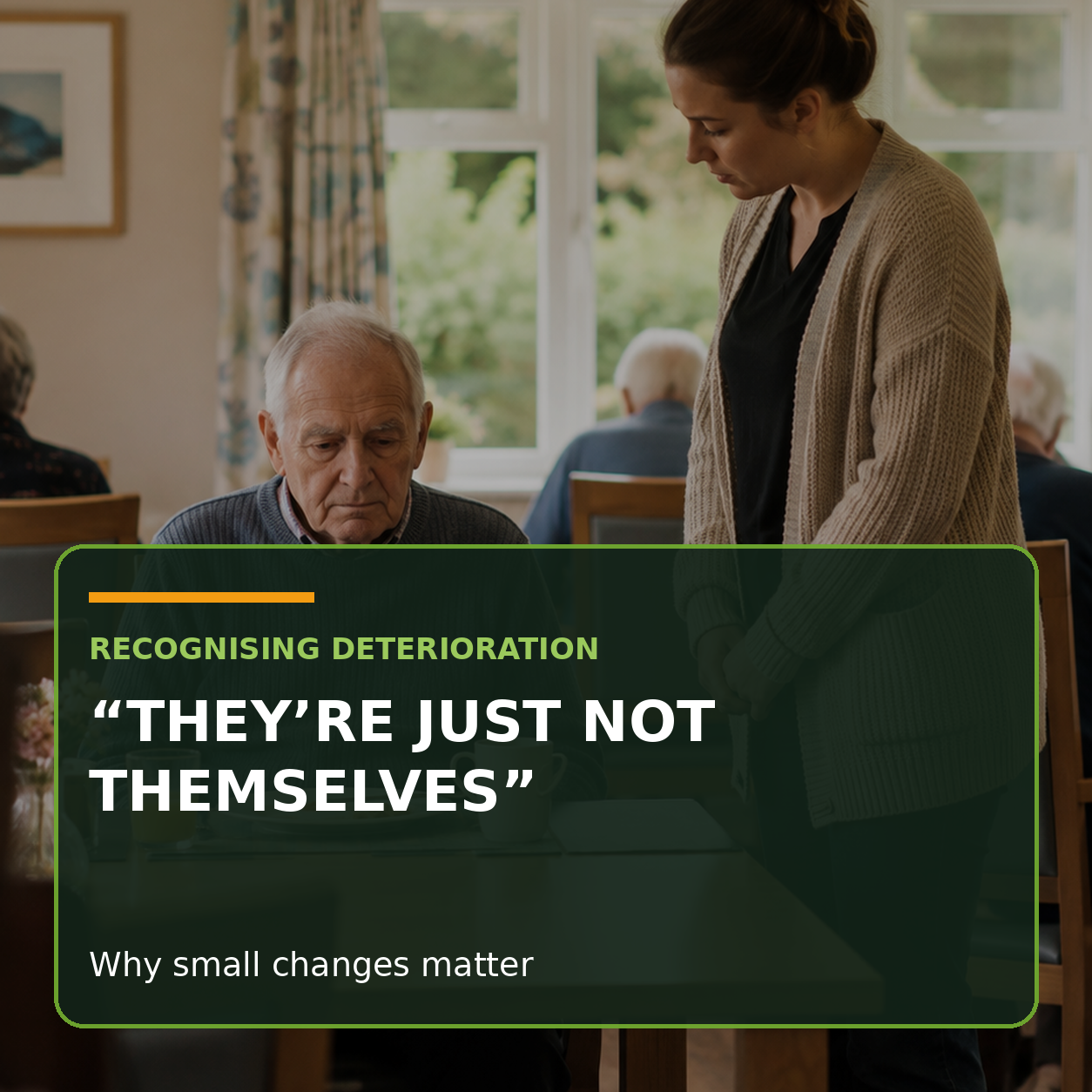
“They’re just not themselves”: recognising soft signs of deterioration
“They’re just not themselves.”
It is a phrase frequently used by care staff and families. It can sound imprecise, but it may describe the earliest warning that someone’s health is beginning to deteriorate.
People do not always become suddenly or obviously unwell. Subtle changes in behaviour, appetite, mobility, communication or alertness may appear before their physiological observations become abnormal. NHS England describes these as “soft signs” of deterioration.
Recognising those changes depends on knowing what is normal for the individual—and taking concerns seriously.
Structured systems make that response clearer and safer. RESTORE2 or RESTORE2mini can help care teams record soft signs, observations and escalation, while SBARD provides a consistent framework for communicating concerns and agreeing the next action.
WHAT ARE SOFT SIGNS OF DETERIORATION?
Soft signs are observable changes that suggest someone may be becoming unwell, even when the cause is unclear.
They may include someone:
- becoming unusually quiet, withdrawn, irritable or distressed
- appearing sleepier, weaker or less alert than usual
- developing new or increased confusion
- eating or drinking noticeably less
- moving differently, becoming less mobile or needing more support
- engaging less with conversation, activities or personal care
- communicating differently or struggling to express themselves
- looking pale, flushed, clammy or generally unwell
- passing less urine, experiencing new incontinence or showing another change in elimination
- saying that they feel unwell, frightened or that “something isn’t right”
Family members and regular care workers may notice a change before anyone else because they understand the person’s usual presentation. Their concern is relevant information, not an inconvenience to be dismissed.
WHY THE PERSON’S BASELINE MATTERS
A single observation only shows what is happening at that moment. It becomes more meaningful when compared with the person’s normal values and usual behaviour.
For example, a temperature within the commonly accepted normal range does not rule out deterioration. Some older or frail people may not develop a marked fever when unwell. Likewise, a National Early Warning Score or another observation tool must support—not replace—professional judgement and knowledge of the person.
Useful baseline information may include the person’s normal:
- level of alertness and orientation
- communication and behaviour
- appetite and fluid intake
- mobility and ability to carry out daily activities
- respiratory rate, oxygen saturation and other observations, where these are routinely monitored
- urine output, bowel pattern and continence
Care plans should make significant baseline information accessible to the staff supporting the person.
WHAT SHOULD CARE STAFF DO?
- Stop and assess the immediate situation
Look at and speak with the person. Check for any immediate danger or life-threatening symptoms. Call 999 for a medical emergency and follow the organisation’s emergency procedures.
Do not leave a person who appears acutely unwell without appropriate support.
- Identify exactly what has changed
Replace the general statement “not themselves” with clear observations wherever possible.
For example:
“Normally, Mary walks to the dining room and talks throughout breakfast. Today she needed help to stand, ate only two spoonfuls and repeatedly fell asleep.”
That description gives a healthcare professional much more useful information than “Mary seems off.”
- Check the person’s plan and take relevant observations
Follow the person’s care plan and your organisation’s deterioration and escalation procedure. Where staff are trained, competent and expected to do so, this may include recording temperature, pulse, respiratory rate, blood pressure, oxygen saturation or level of consciousness.
Use the deterioration tool adopted by the service, such as RESTORE2, RESTORE2mini or another agreed pathway. Record observations accurately and compare them with the person’s baseline and any previous readings.
Do not allow apparently reassuring observations to override genuine concern about a significant change.
- Escalate clearly and promptly
Follow the service’s escalation pathway. Depending on the situation, this may involve a senior member of staff, community nurse, GP, NHS 111 or emergency services.
A structured handover such as SBARD can help communicate:
- Situation: what is happening now
- Background: relevant health information and usual baseline
- Assessment: the changes and observations identified
- Recommendation: what help or review is needed
- Decision: the agreed action, including who will do what and when
Be clear if you remain worried, particularly when the person’s presentation differs significantly from normal.
- Record and monitor
Document:
- the specific changes noticed
- when they began or were first identified
- observations taken and how they compare with previous readings
- actions and supportive care provided
- who was contacted, when and what advice was given
- the agreed monitoring and escalation plan
Ensure incoming staff receive a clear handover. If the person does not improve, deteriorates further or develops new symptoms, escalate again rather than assuming the earlier call has resolved the concern.
AVOIDING DIAGNOSTIC OVERSHADOWING
A change should not automatically be attributed to dementia, a learning disability, mental ill health, ageing or “challenging behaviour.” New confusion, agitation, withdrawal or reduced engagement may reflect pain, infection, constipation, dehydration, low oxygen levels, medicine effects or another physical problem.
Care staff are not expected to diagnose the cause. Their responsibility is to notice the change, gather relevant information, respond within their competence and obtain appropriate help.
THE MESSAGE FOR CARE TEAMS
Early deterioration is not always dramatic. Sometimes it begins with an unfinished drink, an unusually quiet conversation or a person needing help with something they normally manage independently.
Knowing the person gives care staff an important advantage. Use it.
Notice the change. Check the person. Record the facts. Escalate the concern.
Safe Skills Training provides practical clinical and mandatory training for care teams, helping staff recognise risks, communicate concerns and respond safely.
To discuss training for your organisation, visit www.safeskillstraining.com.
SOURCES
NHS England — Managing acute physical deterioration through the PIER approach:
https://www.england.nhs.uk/patient-safety/managing-acute-physical-deterioration-through-the-prevention-identification-escalation-response-pier-approach/
NHS England — Providing proactive care for people living in care homes:
https://www.england.nhs.uk/long-read/providing-proactive-care-for-people-living-in-care-homes-enhanced-health-in-care-homes-framework/
NHS England — Primary care patient safety strategy:
https://www.england.nhs.uk/long-read/primary-care-patient-safety-strategy/