
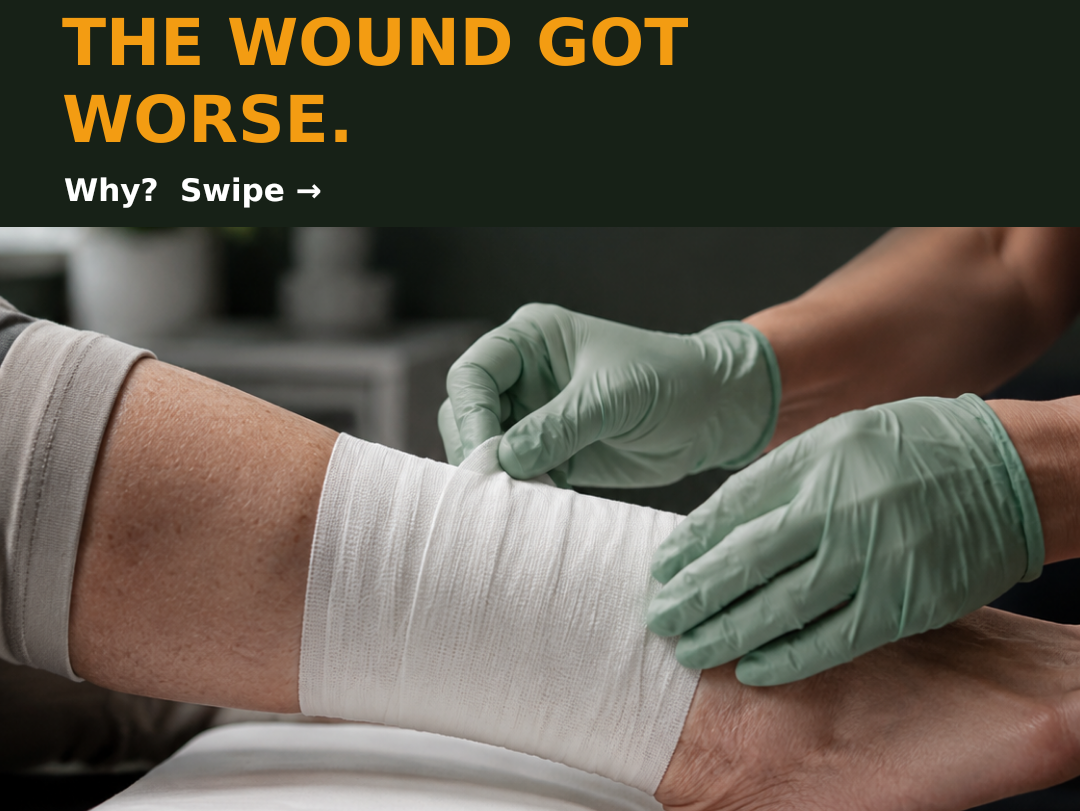
The Dressing Was Changed Correctly—So Why Is the Wound Getting Worse?
The dressing was changed exactly as prescribed. The procedure was completed safely, the correct products were used and the record confirms that the task was done.
Yet the wound continued to deteriorate.
Why is it not improving?
Because applying a dressing correctly is only one part of wound management. A dressing can protect the wound and support the healing environment, but it cannot necessarily remove the pressure, improve poor circulation, correct a nutritional deficiency or identify a developing infection. Good wound care must consider the wound, its likely cause and the person living with it.
A wound does not exist in isolation
Before deciding how a wound should be managed, an appropriately trained clinician needs to complete a holistic assessment. This considers more than the appearance of the wound itself.
Factors that may affect healing include:
- pressure, friction or shear;
- poor arterial or venous circulation;
- oedema;
- diabetes and blood-glucose management;
- reduced mobility or an inability to reposition independently;
- continence, moisture and the condition of the surrounding skin;
- nutrition and hydration;
- pain;
- infection or inflammation;
- medicines and other health conditions;
- smoking, alcohol use and the person's wider circumstances.
The Royal College of Nursing emphasises that a holistic assessment should identify possible causes and consider health history, comorbidities, medicines, lifestyle, nutrition, pain and psychological wellbeing. It also recommends structured reassessment and clear documentation of wound progress. [Read the RCN wound-assessment guidance](https://www.rcn.org.uk/magazines/Clinical/2026/Mar/How-to-perform-a-simple-wound-assessment).
The cause changes the care
Two wounds that look similar may require very different management.
A pressure ulcer will not improve simply because it has been covered with an appropriate dressing if pressure continues to be applied to the area. The wider plan may need to address repositioning, seating, mobility and pressure-redistributing equipment. NICE recommends individualised care planning based on risk, skin assessment, mobility, comorbidities and the need for pressure relief. [Read the NICE pressure-ulcer recommendations](https://www.nice.org.uk/guidance/cg179/chapter/Recommendations).
Likewise, a venous leg ulcer is not managed by a dressing alone. Following appropriate assessment, treatment commonly includes compression delivered by staff trained in the procedure, because the underlying venous circulation and swelling must be addressed. The NHS notes that unless the underlying cause is managed, a venous ulcer has a high risk of returning. [Read the NHS overview of venous leg ulcers](https://www.nhs.uk/conditions/leg-ulcer/).
This is why copying the treatment used for another person—or choosing a product simply because it is described as a “healing dressing”—is unsafe. The dressing plan should follow a proper assessment, diagnosis, local policy and the person's individual care plan.
“Dressing changed” is not enough
Documentation should show more than task completion. Depending on the staff member's role, competence, care plan and local documentation system, meaningful observations may include:
- whether the wound appears larger, deeper or otherwise changed;
- the amount, colour and consistency of exudate;
- odour;
- the condition of the surrounding skin;
- changes in pain;
- heat, swelling or other possible signs of inflammation or infection;
- whether wound edges appear to be progressing;
- whether the dressing remains secure and manages exudate between changes;
- any change in the person's mobility, appetite, hydration or general condition.
Formal wound assessment and treatment decisions must be made by staff with the appropriate skills and competence. However, everyone involved in the person's care needs to understand what they are expected to observe, record and report.
A care worker may not be responsible for diagnosing infection or selecting a dressing, but they could be the first person to notice increased pain, a new odour, a saturated dressing, reduced appetite or that the person seems unusually unwell. Those observations can be clinically significant.
When deterioration needs escalation
A wound that is not progressing as expected should not simply generate another identical entry at the next dressing change.
Staff should follow the care plan and local escalation process when there is delayed or stalled healing, a significant change in the wound, concern about the surrounding skin, increasing pain, suspected infection or deterioration in the person's general condition. Urgent clinical help may be required where the person is acutely unwell.
The RCN identifies unresolved signs of infection, delayed or stalled healing, complex wounds, underlying comorbidities and dressing or compression difficulties among the reasons for specialist escalation. Its current guidance also highlights redness, swelling, heat, pain, odour, increased exudate, fever and tiredness as possible local or systemic warning signs. Redness can be less visible in darker skin tones, so assessment must not depend on colour change alone.
Good wound care is a team responsibility
Safe wound management depends on people knowing both the limits and the importance of their role.
The clinician completing the assessment needs accurate information. The person applying the dressing needs the practical competence to follow the treatment plan safely. The staff supporting mobility, repositioning, nutrition, hydration, continence and day-to-day care need to understand how those elements connect with healing. Managers need systems that support consistent documentation, communication and escalation.
The goal is not for every staff member to make clinical decisions beyond their role. It is for everyone involved to recognise that wound care is more than a dressing task.
**Observe. Compare. Document. Escalate.**
Good wound care treats the person and addresses the cause—not simply the hole in the skin.
Develop safer, more confident wound-care practice
Safe Skills Training's Complex Wound Management training connects practical wound care with clinical reasoning, meaningful observation, documentation and timely escalation. Training can be adapted to the needs and responsibilities of your team.
Hit the 'contact' link to discuss training for your organisation.