
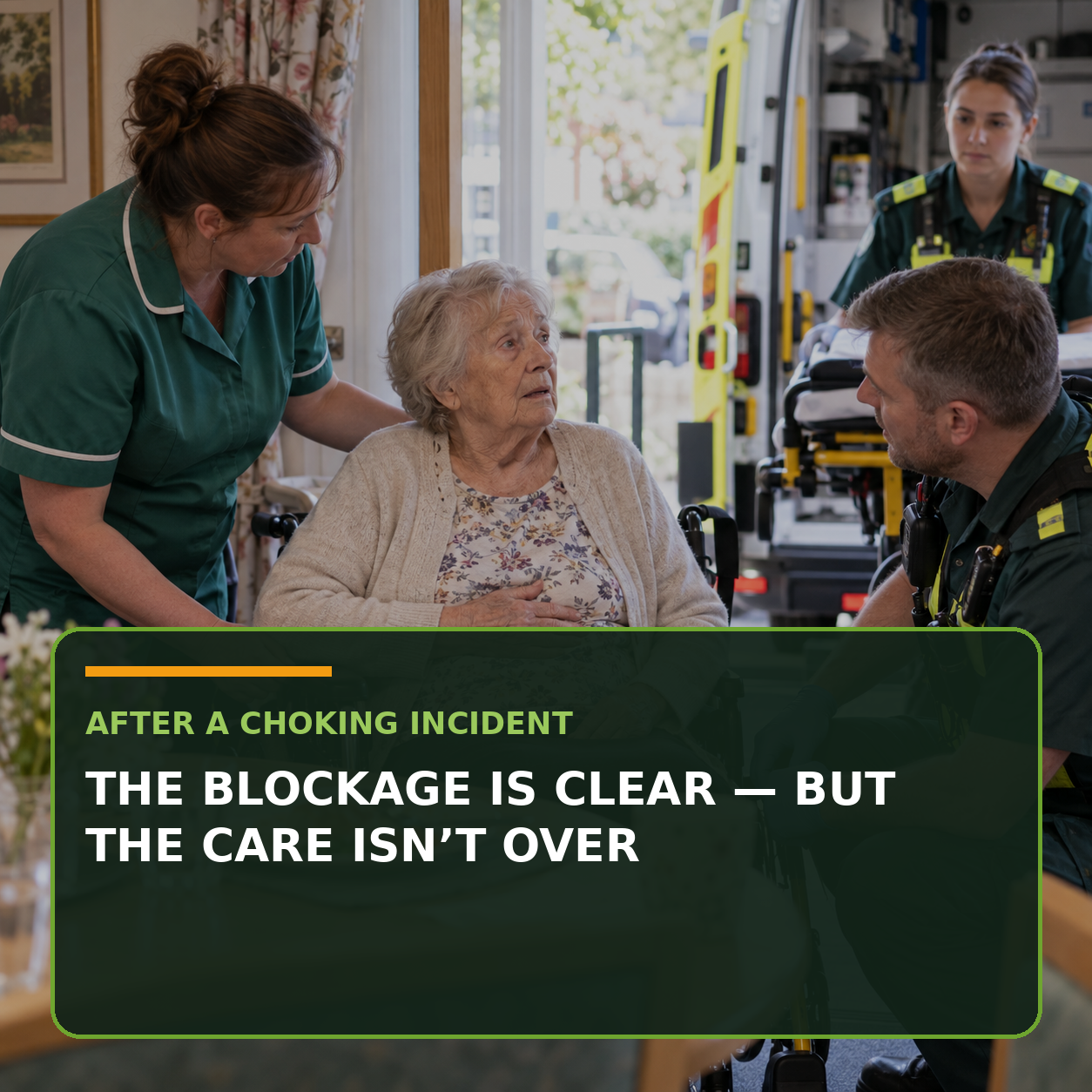
The blockage is clear — but is the choking incident over?
When a person begins breathing again after choking, it is natural to feel that the emergency has passed. In adult social care, however, clearing the obstruction is only the first stage of a safe response.
The person may still have an airway problem, may have inhaled food or fluid, or may have sustained an internal injury during first aid. Staff also need to establish why the incident occurred and whether anything must change before the person next eats or drinks.
AFTER ABDOMINAL THRUSTS: HOSPITAL IS NOT OPTIONAL
Abdominal thrusts can cause injury to the ribs, abdominal organs and other internal structures. In adult social care, if abdominal thrusts have been used, the person must attend hospital for assessment and X-rays — even when the obstruction has cleared and they appear fully recovered.
This should not be replaced by a routine GP appointment, a telephone consultation or an informal check by a healthcare professional at the service. Follow the organisation’s emergency procedure and give the ambulance service a clear account of the choking episode and the first aid provided.
If the person became unresponsive or required chest compressions, emergency hospital care will already be required.
DO NOT “TEST” SWALLOWING WITH FOOD OR DRINK
Once the airway is clear, staff should not simply offer another mouthful or a drink to see whether the person can swallow. This could expose them to another choking or aspiration event.
Follow clinical advice and the person’s current swallowing plan. If there is any uncertainty about whether oral intake is safe, escalate before offering food, drink or oral medicines.
CONTINUE TO OBSERVE AND ESCALATE
Remain alert to delayed or continuing problems, including:
- difficulty or noise when breathing
- persistent coughing, wheezing or throat clearing
- a change in voice quality
- chest, rib or abdominal pain or tenderness
- vomiting, increasing distress or unusual drowsiness
- reduced oxygen saturation or other signs of deterioration
Call 999 if there is breathing difficulty, renewed obstruction, reduced consciousness or other serious deterioration. Where staff are trained and it is within local policy, record appropriate observations and use RESTORE2 or RESTORE2mini to support recognition and escalation — without allowing the score to delay urgent action.
RECORD WHAT ACTUALLY HAPPENED
Good documentation should allow another professional to understand the incident without relying on assumptions. Record:
- what the person was eating or drinking
- the prescribed texture or IDDSI level
- their position and the supervision provided
- the signs that indicated choking
- each first-aid intervention and the person’s response
- whether abdominal thrusts or chest compressions were used
- observations and symptoms following the event
- who was contacted, the advice received and the transfer arrangements
Use SBARD — Situation, Background, Assessment, Recommendation and Decision — to structure escalation and handover. The receiving team must be told explicitly that abdominal thrusts were performed and that the person requires assessment for possible internal injury.
REVIEW THE RISK BEFORE THE NEXT MEAL
A choking incident should trigger more than an incident form. Review the circumstances and consider whether the person needs clinical or Speech and Language Therapy (SALT) assessment.
The review should consider:
- whether the current IDDSI food and drink levels remain appropriate
- whether food was prepared and tested correctly
- positioning, alertness, fatigue and pace of eating
- the size of mouthfuls and level of prompting or assistance
- dentures, oral health and ability to chew
- distraction, staffing and mealtime supervision
- recent illness, neurological change or other deterioration
Update the care plan, risk assessment and mealtime guidance when indicated, and make sure the changes are communicated to everyone supporting the person.
LEARN, DON’T NORMALISE
A resolved choking episode can easily be described as a “near miss” and then forgotten. That loses an important opportunity to prevent recurrence.
Safe post-choking care means arranging the required hospital checks, recognising delayed problems, documenting and handing over clearly, and reviewing the individual swallowing risks before care returns to normal.
Safe Skills Training provides practical, care-focused training in choking response, dysphagia, IDDSI and clinical escalation. To discuss training for your team, visit www.safeskillstraining.com.