
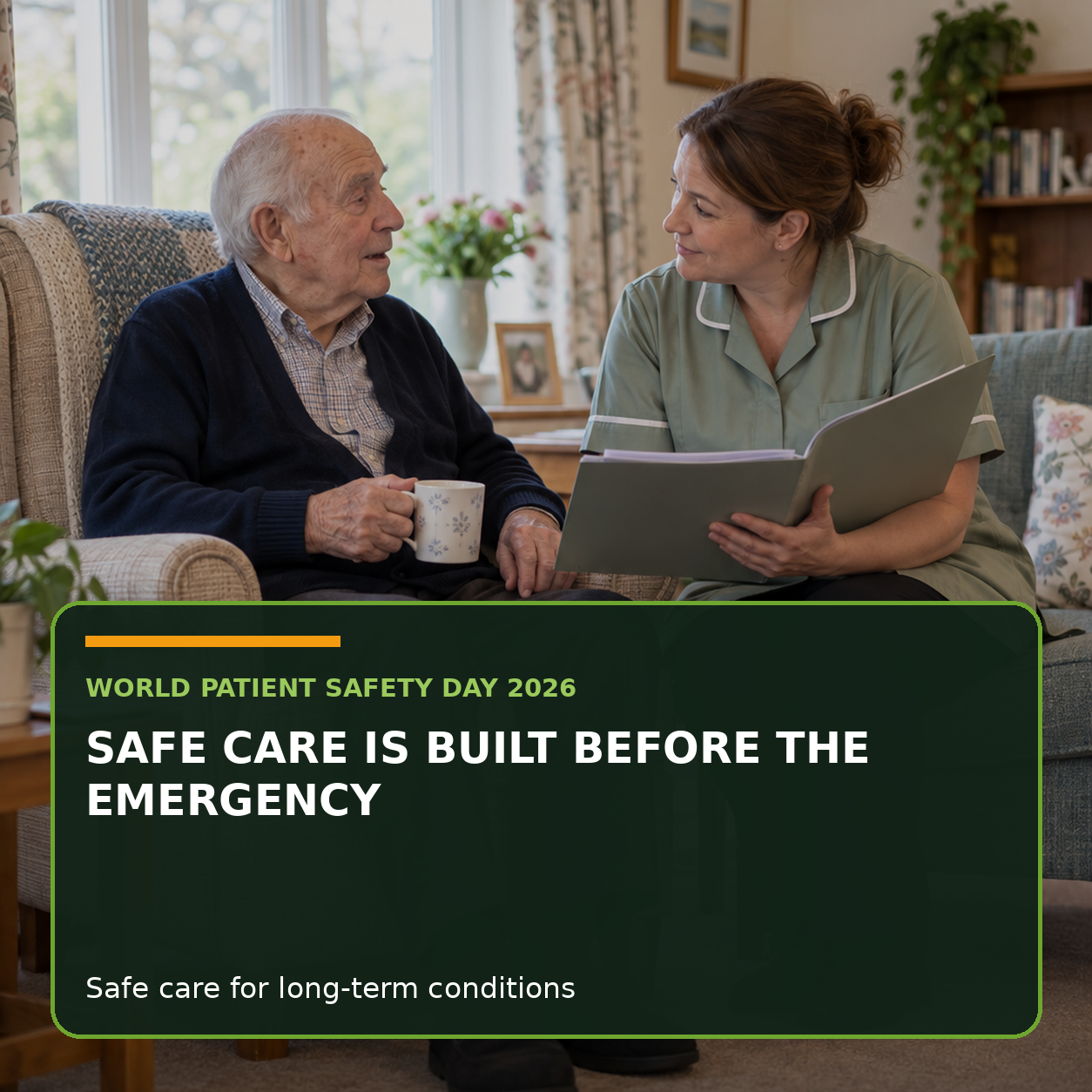
Safe care for long-term conditions: prepared before the emergency
World Patient Safety Day takes place on 17 September. The World Health Organization’s 2026 theme is “Safe care for noncommunicable diseases”, under the slogan “Safe care for life!”.
Noncommunicable diseases are long-term conditions such as cardiovascular disease, diabetes, cancer and chronic respiratory disease. Many people receiving adult social care live with one or more long-term conditions and depend upon safe, coordinated support every day.
Patient safety in this context is not limited to responding correctly when somebody becomes seriously unwell. It begins much earlier: with individual planning, accessible information, competent staff, available medicines and equipment, recognition of change and clear escalation.
The safest emergency response is often built before the emergency happens.
- KNOW THE PERSON—NOT ONLY THE DIAGNOSIS
Two people with the same diagnosis may have very different risks, warning signs and support needs.
A useful care plan should tell staff:
- what is normal for this person
- their usual symptoms and observations, where relevant
- their known triggers and risks
- what early deterioration may look like for them
- what they can manage independently
- the support they want and need
- which actions staff are authorised and competent to undertake
- when and how concerns must be escalated
The person should be involved in developing and reviewing the plan wherever possible. Families and relevant professionals may also hold important information, but the person must remain a partner in their own care—not simply the subject of a document.
- MAKE THE PLAN USABLE DURING A REAL SHIFT
A technically detailed plan is not safe if staff cannot find it, understand it or apply it quickly.
Check whether:
- the current version is clearly identified
- paper and electronic records are consistent
- instructions are specific rather than vague
- emergency contacts and escalation routes are current
- agency, temporary and new staff know where to find essential information
- important changes are included in handovers
- the plan is available when care is delivered away from the main service
Avoid instructions such as “monitor closely” without explaining what should be monitored, how often, what change matters and what action to take.
- CHECK MEDICINES, EQUIPMENT AND ACCESS
Long-term condition care may depend upon time-critical medicines, rescue treatments or monitoring equipment. A written plan cannot compensate for missing, expired or inaccessible resources.
Depending upon the person’s needs, checks may include:
- medicines are available, in date and stored correctly
- rescue medicines can be accessed without avoidable delay
- equipment is clean, functioning and charged
- the correct consumables are available
- staff know how to obtain replacements
- instructions travel with the person when appropriate
- staff understand what to do if equipment fails
Examples might include blood-glucose equipment and hypo treatment, inhalers and spacers, oxygen equipment, seizure rescue medicines, enteral-feeding equipment or other individually prescribed resources.
Staff must work within their training, competence, authorisation and the person’s agreed plan. Availability alone does not make an intervention safe.
- RECOGNISE SOFT SIGNS AND CHANGES FROM NORMAL
Deterioration is not always announced by an obviously abnormal observation. Care staff may first notice that a person is:
- quieter, sleepier or less engaged
- newly confused or behaving differently
- eating or drinking less
- weaker or less mobile
- more breathless than usual
- reporting new or different pain
- passing less urine
- looking pale, flushed or generally unwell
These observations matter because care staff often know the person’s normal presentation better than visiting professionals.
Do not dismiss a change as age, dementia, disability or “how they usually are” without checking the person’s baseline and considering a physical cause.
- USE THE AGREED DETERIORATION AND ESCALATION PROCESS
Services should have a clear process for recognising, assessing and escalating deterioration.
RESTORE2 is a physical-deterioration and escalation tool developed for care and nursing homes. It brings together soft signs, observations, the National Early Warning Score 2 (NEWS2), escalation and structured communication. Where RESTORE2 is implemented, staff must be trained for the parts of the tool they are expected to use.
Not every social-care service uses RESTORE2, and it should not be inserted into practice informally. Domiciliary-care services and other settings must follow their commissioned pathways, organisational policy and the person’s plan.
No score or tool replaces clinical judgement. If somebody appears seriously unwell, has a time-critical symptom or meets the emergency criteria in their plan, staff should seek urgent help without delaying for a complete set of observations.
- COMMUNICATE CLEARLY USING SBARD
SBARD can help staff organise an escalation call:
Situation — Who are you calling about, and what is happening now?
Background — What relevant condition, history, medicines, risks or recent events should the clinician know?
Assessment — What has changed? Include soft signs, observations and actions already taken.
Recommendation — What help, review or decision is needed?
Decision — Record what was agreed, including actions, monitoring, timescales and escalation thresholds.
SBARD supports communication; it does not restrict staff from describing an urgent concern in plain language. Begin with the immediate risk, then add the relevant detail.
- RECORD, REVIEW AND LEARN
Safe care continues after advice has been obtained or an immediate episode has resolved.
Record:
- what changed and when it was noticed
- observations and their times
- actions and treatment provided
- who was contacted
- advice and decisions received
- the person’s response
- further monitoring and escalation instructions
The service should then consider whether the care plan, risk assessment, equipment, staffing, training or communication process needs updating.
Repeated incidents should not become accepted as routine. They may reveal an unresolved clinical problem or a weakness in the system supporting the person.
A FIVE-QUESTION SAFETY CHECK
For each person living with a long-term condition, ask:
- Would staff recognise an important change from this person’s normal presentation?
- Can they immediately find the current plan and escalation instructions?
- Are the required medicines and equipment available and ready?
- Are staff trained, competent and authorised for the actions expected of them?
- Can they communicate, document and follow through clearly when something changes?
If any answer is uncertain, the service has identified useful work to complete before an emergency occurs.
Safe Skills Training provides practical clinical-skills, medicines and patient-safety training for adult social-care teams. To discuss training for your service, visit www.safeskillstraining.com.
GUIDANCE AND FURTHER INFORMATION
World Health Organization: World Patient Safety Day 2026
https://www.who.int/campaigns/world-patient-safety-day/2026
Health Innovation Wessex: RESTORE2
https://healthinnovationwessex.org.uk/projects/restore2/
Care Quality Commission: Regulation 9—Person-centred care
https://www.cqc.org.uk/guidance-regulation/providers/regulations-service-providers-and-managers/health-social-care-act/regulation-9
Care Quality Commission: Regulation 12—Safe care and treatment
https://www.cqc.org.uk/guidance-regulation/providers/regulations-service-providers-and-managers/health-social-care-act/regulation-12
Care Quality Commission: Regulation 17—Good governance
https://www.cqc.org.uk/guidance-regulation/providers/regulations-service-providers-and-managers/health-social-care-act/regulation-17
Care Quality Commission: Regulation 18—Staffing
https://www.cqc.org.uk/guidance-regulation/providers/regulations-service-providers-and-managers/health-social-care-act/regulation-18