
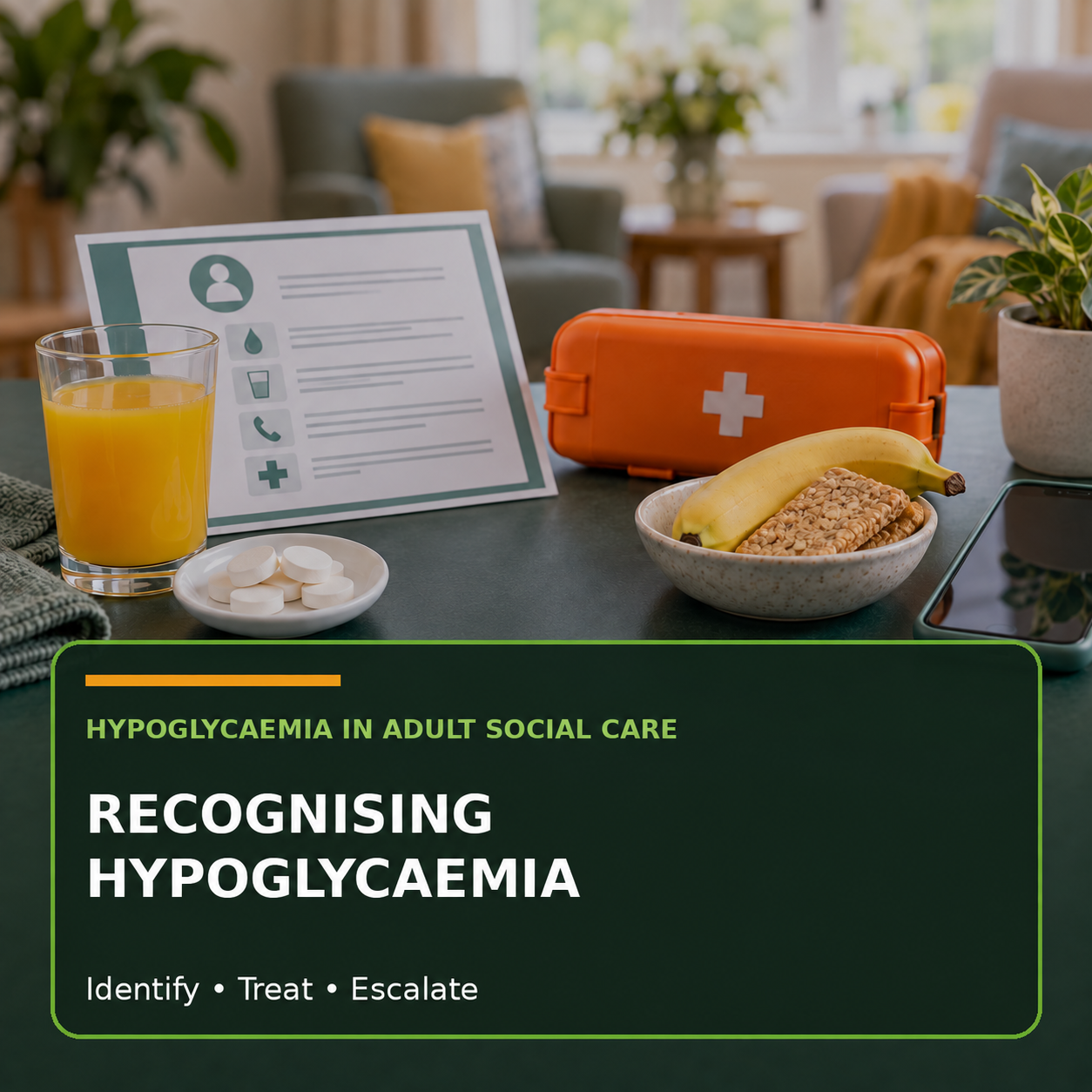
Recognising and responding to hypoglycaemia in adult social care
A service user becomes unsteady, confused or unusually irritable. Their speech sounds slurred and their coordination has changed. Their behaviour presents as though they may have been drinking—but there is no smell of alcohol.
This is a presentation learners often recognise when it is described in the classroom. It is also an important warning sign of hypoglycaemia.
Low blood glucose can alter cognition, speech, balance and behaviour. If staff interpret this simply as intoxication, dementia, tiredness or “challenging behaviour”, treatment may be dangerously delayed.
WHAT IS HYPOGLYCAEMIA?
Hypoglycaemia means that the blood glucose level has fallen too low. In adults with diabetes, a reading below 4 mmol/L is generally treated as a hypo.
It is most often associated with insulin and some glucose-lowering medicines, particularly sulfonylureas. Common triggers include:
- a delayed or missed meal
- eating less carbohydrate than usual
- vomiting or poor appetite
- too much insulin or a medicine-administration error
- increased activity
- alcohol
- illness
- impaired kidney or liver function
Some people experience hypos without recognising the early symptoms. Older people may also present less typically, with confusion, drowsiness, weakness, falls or behavioural change.
THE “APPEARS INTOXICATED” CLUE
A person experiencing a hypo may:
- become unsteady or poorly coordinated
- slur their speech
- appear confused or disorientated
- behave unusually, irritably or aggressively
- have difficulty concentrating or following instructions
- become drowsy
Unlike alcohol intoxication, there may be no smell of alcohol and no history suggesting that alcohol has been consumed.
Do not waste time arguing about the behaviour. If the person has diabetes or takes medicines that can cause hypoglycaemia, check their glucose promptly when staff are trained and equipment is available.
OTHER POSSIBLE WARNING SIGNS
Symptoms vary between individuals. Look for:
- sweating
- shaking or trembling
- pallor
- hunger
- dizziness
- headache
- tingling around the lips
- palpitations
- anxiety
- weakness
- blurred vision
- confusion or unusual behaviour
The person’s individual diabetes plan should describe their usual warning signs, treatment and escalation arrangements.
IF THE PERSON IS AWAKE AND SAFE TO SWALLOW
Follow the individual diabetes and hypoglycaemia plan. Standard adult guidance usually recommends 15–20g of fast-acting carbohydrate, such as the specified quantity of:
- glucose or dextrose tablets
- glucose gel when the person can use it safely
- fruit juice
- a non-diet sugary drink
Recheck the blood glucose after 10–15 minutes.
If it remains below 4 mmol/L, repeat the fast-acting treatment in accordance with the individual plan. Continue checking at the stated interval until the glucose is above 4 mmol/L and the person has recovered.
Chocolate, biscuits and cake are not suitable as the initial fast treatment. Their fat content slows glucose absorption. They may have a role later as longer-acting carbohydrate if included in the person’s plan.
AFTER THE GLUCOSE IS ABOVE 4 MMOL/L
When the person has recovered and can swallow safely, give longer-acting carbohydrate if their plan requires it. This may be:
- the next meal if it is due
- bread, toast or a sandwich
- biscuits
- another planned carbohydrate snack
Continue observing the person. A normal reading does not remove the need to understand what caused the episode or to watch for recurrence.
WHAT IF THE PERSON HAS DYSPHAGIA?
Never assume that juice, sweets, tablets or gel are safe for everyone.
The hypoglycaemia plan must reflect the person’s current swallowing assessment and prescribed IDDSI food and fluid levels. Staff should know in advance:
- which fast-acting treatment is safe
- the required consistency
- the correct measured quantity
- what to do if the person cannot take the treatment safely
- when emergency medication and urgent clinical help are required
Do not give anything orally when the person cannot swallow safely.
IF THE PERSON IS UNCONSCIOUS, FITTING OR CANNOT SWALLOW
This is an emergency.
- Do not give food, drink, tablets or glucose gel by mouth.
- If the person is breathing normally, place them in the recovery position and maintain their airway.
- Call 999 and follow the individual emergency plan.
- Give glucagon only when it is available for that person, its use is authorised within the plan and the member of staff is trained and competent.
- Stay with the person and monitor their breathing and response.
- If they are not breathing normally, begin CPR and use an automated external defibrillator as soon as available.
Never delay emergency help while trying repeatedly to obtain a glucose reading.
CONTINUOUS GLUCOSE MONITORS
A continuous or flash glucose monitor can provide useful warning information, but readings can lag behind blood glucose and may occasionally be inaccurate. Follow the individual plan regarding finger-prick confirmation, especially when symptoms do not match the sensor reading or the level is changing rapidly.
If the person has clear symptoms of a hypo, do not allow uncertainty about the device to delay the response described in their plan.
DOCUMENT AND ESCALATE USING SBARD
Record:
- the time symptoms were first noticed
- the symptoms or behaviour observed
- glucose readings and times
- treatment given, including the quantity
- repeat readings
- the person’s response
- food intake, activity, illness and recent medicines
- who was contacted and the advice received
SBARD can structure clinical communication:
Situation — the person is experiencing or has experienced hypoglycaemia.
Background — their diabetes type, medicines, recent intake, illness and previous hypos.
Assessment — symptoms, glucose readings, treatment and response.
Recommendation — the review or advice required.
Decision — record the agreed action, monitoring and escalation threshold.
REVIEW WHY IT HAPPENED
A hypo should not be treated and then forgotten. The service should consider whether:
- a meal or snack was missed or delayed
- the person ate less than expected
- insulin timing matched food availability
- a medicine error occurred
- activity or illness changed their needs
- hypo treatments were immediately accessible
- staff followed the current individual plan
- the plan, risk assessment or staff training requires review
Repeated or severe hypos require clinical review.
THE PRACTICAL MESSAGE
If someone with diabetes appears intoxicated but there is no smell of alcohol, think beyond behaviour:
- recognise the warning signs
- check glucose promptly when trained
- treat below 4 mmol/L according to the individual plan
- recheck after 10–15 minutes
- give nothing orally if swallowing is unsafe
- call 999 for severe hypoglycaemia
- document, escalate and review the cause
Safe Skills Training provides practical diabetes, medicines and clinical-skills training designed for adult social-care teams. To discuss training for your service, visit www.safeskillstraining.com.
GUIDANCE
NHS: Low blood sugar (hypoglycaemia)
https://www.nhs.uk/conditions/low-blood-sugar-hypoglycaemia/
Diabetes UK: What is hypoglycaemia?
https://www.diabetes.org.uk/about-diabetes/looking-after-diabetes/complications/hypos