
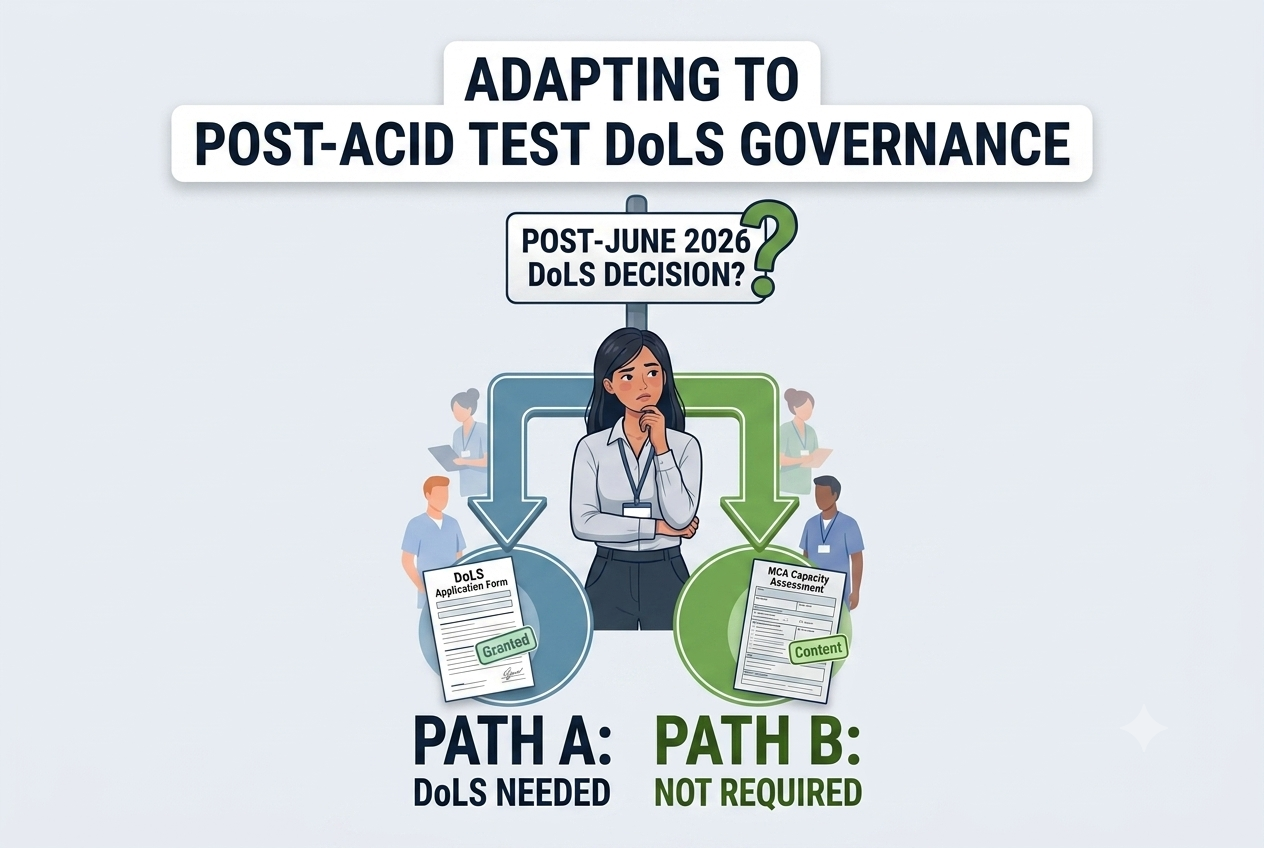
Post-Acid Test MCA & DoLS Care Governance
Following the landmark June 2026 Supreme Court ruling, the legal framework governing the Deprivation of Liberty Safeguards (DoLS) has fundamentally shifted. By overturning the 2014 Cheshire West "acid test", the court removed the rigid assumption that continuous supervision automatically equates to a deprivation of liberty.
In its place, care providers must now implement a broader, multifactorial assessment that considers the whole context of a resident's life, including whether they are content and expressing valid, practical agreement with their care arrangements.
However, during a CQC inspection, simply knowing the legal definition changed isn't enough. Inspectors under "Well-Led" and "Safe" look for evidence that your senior team can apply this nuanced framework and ensure that where DoLS authorizations are active, their specific conditions are embedded into daily practice.
The Pitfalls of Modern DoLS Compliance Navigating post-judgment compliance creates three distinct operational risks on the floor:
- Relying on Outdated "Acid Test" Triage: Continuing to treat every supervised resident as a DoLS case, rather than evaluating individual degree, intensity, and resident contentment.
- Unmet BIA Conditions: Filing away granted DoLS authorizations without tracking whether specific conditions set by the Best Interests Assessor (BIA) are being actively delivered on shift.
- Overlooking Resident Wishes and Expressions: Failing to document a resident’s day-to-day contentment or objections, which are now central to determining whether a restriction amounts to a deprivation of liberty.
Building a Dynamic MCA & DoLS Framework To ensure watertight governance under current law, clinical educators must train Unit Leads and Senior Carers to manage legal safeguards as active, living workflows:
- 1. Multifactorial Evaluation: Train leads to assess care arrangements holistically—considering the normality of the environment, individual baseline limitations, and whether the resident is genuinely content.
- 2. Condition Mapping: Convert every granted DoLS condition directly into a clear, traceable daily task within the resident’s digital or paper care plan.
- 3. Documenting "Incapacitous Consent": Upskill shift leads to record a resident’s verbal and behavioral feedback accurately, providing the evidence trail needed to determine if a formal DoLS remains legally necessary.
Upskilling for Active Compliance Empowering your senior care leads to understand the post-2026 legal landscape transforms your home's compliance culture. When your floor leads can confidently explain to an inspector how resident wishes are evaluated, how least-restrictive practices are maintained, and how DoLS conditions are actively fulfilled every single day, you demonstrate the highest standard of person-centred governance.