
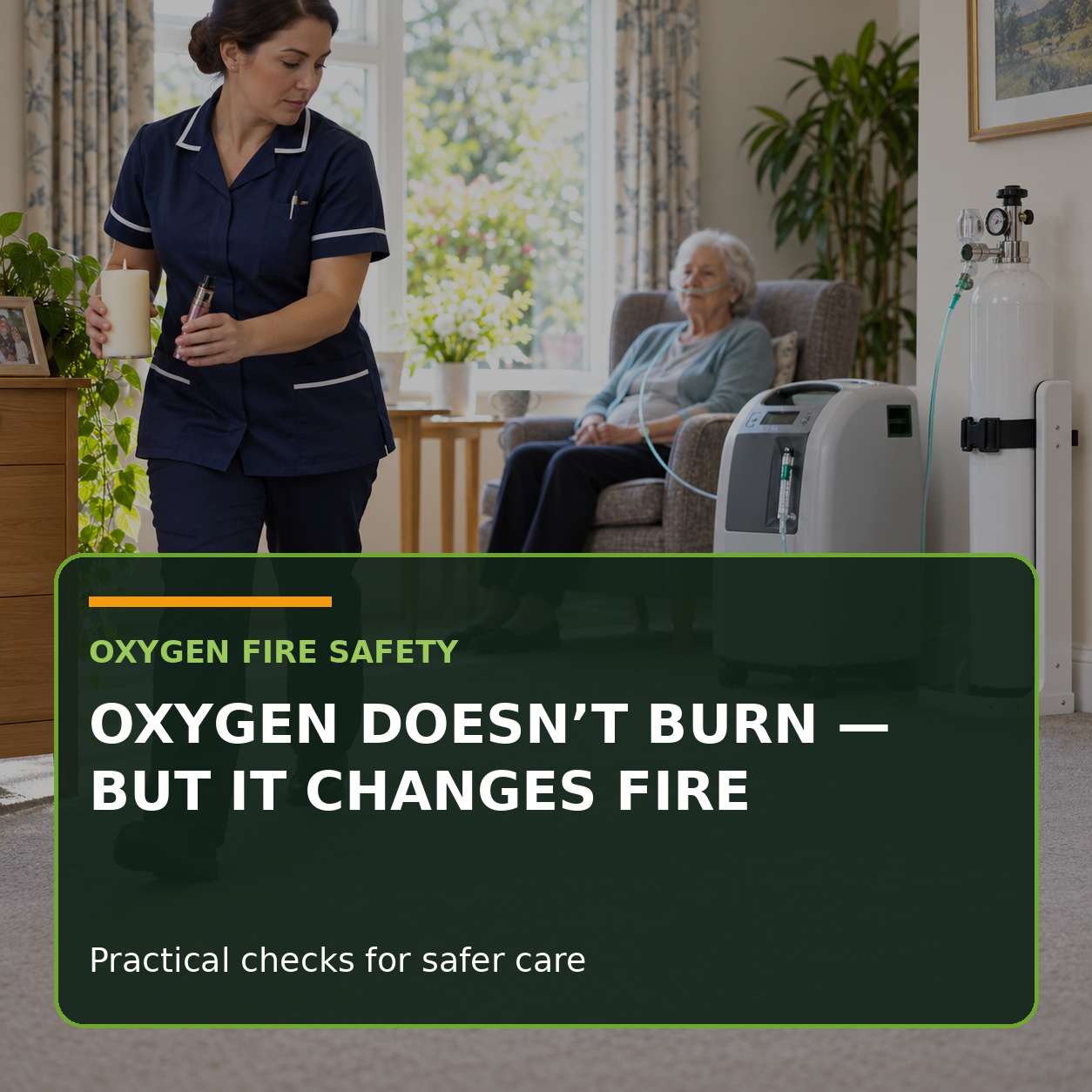
Oxygen doesn’t burn—but it can make fire deadly fast
Oxygen itself is not flammable. It does not burn and it does not explode on its own.
However, extra oxygen in the air, in clothing or in bedding can make other materials ignite more easily and burn much faster and more fiercely. A small flame or spark that might normally be manageable can therefore become a serious fire within seconds.
For care homes and home-care services, safe oxygen support involves far more than checking that a nasal cannula is in place. Staff must understand the prescription, recognise fire hazards and follow the person’s individual risk controls every time oxygen is used.
Treat oxygen as a medicine
The Care Quality Commission describes oxygen as a medical gas that should be treated as a medicine. It must be prescribed for an individual person and administered exactly as directed.
Care staff should be able to confirm:
- why the oxygen has been prescribed
- the prescribed flow rate and duration
- which delivery equipment should be used
- whether oxygen is continuous or used only in specified circumstances
- what monitoring is required
- what to do if the person’s condition changes or the equipment fails
- who to contact for clinical advice or equipment support
Never increase or reduce the flow rate without appropriate clinical authorisation. Oxygen can be harmful when used incorrectly, and a higher flow is not automatically a safer response to breathlessness.
The current prescription, care plan and supplier instructions must be available to staff. Any discrepancy should be resolved before administration wherever possible, or escalated immediately if oxygen is urgently required.
What is IHORM?
IHORM is the Initial Home Oxygen Risk Mitigation Form. It supports the assessment and communication of risks when home oxygen is ordered, including fire, falls and the person’s ability to use the equipment safely.
The completed IHORM does not remove the provider’s responsibility to assess and manage risks in the actual care environment. Circumstances can change after oxygen is installed. New smoking or vaping, increasing confusion, changes to mobility, damaged equipment, additional electrical devices or a move to another room may require review and escalation.
Care providers should incorporate the relevant controls into the person’s care plan and their own fire-risk arrangements. Staff must know where those instructions are and what action to take if a control is no longer effective.
Remove every source of ignition
There must be no smoking or vaping while oxygen is being used or in an oxygen-enriched environment. Cigarettes, e-cigarettes, charging devices, candles, incense, open fires and gas flames all introduce ignition risks.
Electrical equipment can also create heat or sparks. Follow the oxygen supplier’s instructions regarding safe positioning and separation from appliances, radiators and other heat sources. Do not use extension leads, adapters or equipment arrangements that have not been risk assessed.
Visitors, agency workers and temporary staff may not know that oxygen is in use. Clear communication, appropriate safety notices and consistent enforcement of the controls are essential. If someone refuses to comply with smoking or fire-safety requirements, staff should not quietly accept the risk: follow the escalation procedure and contact the relevant manager or home oxygen service.
Emollients create a hidden fabric risk
Emollient creams, ointments, lotions and sprays can transfer from the skin onto clothing, bedding, bandages, dressings and upholstered furniture. As residue builds up, those fabrics can ignite more easily and burn more intensely.
This warning applies to paraffin-free as well as paraffin-containing emollients. The product itself is not necessarily flammable in its container; the major danger is residue that has dried into fabric.
Washing clothing and bedding regularly may reduce the build-up, but it does not remove the risk completely. People using emollients—and everyone supporting them—must be kept away from cigarettes, vapes, candles, naked flames and other ignition sources.
When oxygen and emollient use occur together, the risks must be considered as part of the individual care and fire-safety assessment. Record the products used, identify affected clothing or bedding, provide clear safety information and escalate concerns when controls are not being followed.
Store and handle equipment safely
Oxygen cylinders should be secured upright in an appropriate stand or storage system and protected from falling, impact, excessive heat and unauthorised access. Do not leave a cylinder loose on a bed, chair or floor.
Concentrators need adequate ventilation and must not be covered or placed where air inlets can be blocked. Tubing should be routed to reduce trip and entanglement risks without creating tight bends or trapping it under furniture.
Staff should check the equipment before use and report damage, leaks, unusual noise, alarms, contaminated connectors or missing components. Keep oxygen equipment free from oil and grease and use only compatible items supplied or approved for the system.
Emergency and backup arrangements should account for power cuts, concentrator failure and evacuation. Staff must know how to contact the oxygen supplier and where any authorised backup cylinder is kept.
Plan for a fire before one happens
The individual oxygen assessment must connect with the provider’s wider fire-risk assessment and emergency plan.
Managers should consider:
- how staff and visitors know oxygen is present
- whether smoking and ignition controls are realistic and enforced
- the person’s ability to understand and follow safety advice
- how oxygen equipment affects escape routes
- how the person would be supported during evacuation
- who may safely isolate the oxygen supply, and under what circumstances
- whether staff know how to raise the alarm and call 999
- whether the fire and rescue service or oxygen provider should be involved in planning
If a fire starts, raise the alarm, call 999 and follow the evacuation plan. Staff should only isolate the oxygen supply if this can be done safely and they have been trained to do so. Never delay evacuation or re-enter a dangerous area to retrieve equipment.
A practical oxygen safety check
Before oxygen is used, ask:
- Is this the correct person, equipment and prescribed flow rate?
- Are cigarettes, vapes, flames, heat and spark sources controlled?
- Are emollient-contaminated clothing, bedding or dressings recognised in the risk assessment?
- Is the equipment positioned, ventilated and secured correctly?
- Are tubing and cables creating a falls or entanglement risk?
- Do staff know the emergency, equipment-failure and escalation procedures?
- Have any changes occurred that require the IHORM, care plan or fire-risk controls to be reviewed?
The presence of oxygen should never become so familiar that staff stop seeing the risk. Safe practice requires the same careful checks on every shift.
Safe Skills Training provides practical oxygen-therapy, medicines and patient-safety training for care teams. To discuss training for your service, visit www.safeskillstraining.com.
GUIDANCE LINKS
Care Quality Commission — Managing oxygen in care homes:
https://www.cqc.org.uk/guidance-regulation/adult-social-care/medicines-information-adult-social-care-services/managing-oxygen-care-homes
Care Quality Commission — Managing oxygen in people’s own homes:
https://www.cqc.org.uk/guidance-providers/adult-social-care/managing-oxygen-in-peoples-own-homes
NHS England — Initial Home Oxygen Risk Mitigation Form and guidance:
https://www.england.nhs.uk/coronavirus/wp-content/uploads/sites/52/2020/04/IHORM-IG-appoved-v1-3.pdf
MHRA — Emollients and risk of severe and fatal burns:
https://www.gov.uk/drug-safety-update/emollients-and-risk-of-severe-and-fatal-burns-new-resources-available