
MHRA Safety Alerts & Care Home Governance
Beyond the Inbox: Transforming MHRA Safety Alerts into Active Clinical Governance
When a Central Alerting System (CAS) or Medicines and Healthcare products Regulatory Agency (MHRA) safety notification arrives, how quickly does it translate into action on the floor? For many care home managers, safety alerts are printed out, signed by a supervisor, and filed away in a compliance binder.
However, during a CQC inspection, simply showing a signed alert notification is not enough. Inspectors under the "Safe" and "Well-Led" key lines of enquiry want clear, traceable evidence of how that alert altered daily practice, influenced resident care plans, and mitigated clinical risk.
The Danger of "Passive Acknowledgment" When an alert is issued—whether it involves a medical device recall, a change in monitoring protocols for high-risk medications like anticoagulants or valproate, or updated storage requirements—a passive response leaves your registration vulnerable.
A static paper log creates three distinct operational risks:
- Unidentified Resident Caseloads: Knowing an alert exists without immediately auditing which specific residents are currently prescribed the affected medication or using the recalled device.
- Inconsistent Shift Handovers: Failing to ensure night staff and agency nurses are briefed on revised administration or monitoring protocols.
- Lack of Evidence for Closed Loops: Being unable to prove to an inspector that an action plan was completed, re-audited, and fully resolved across all units.
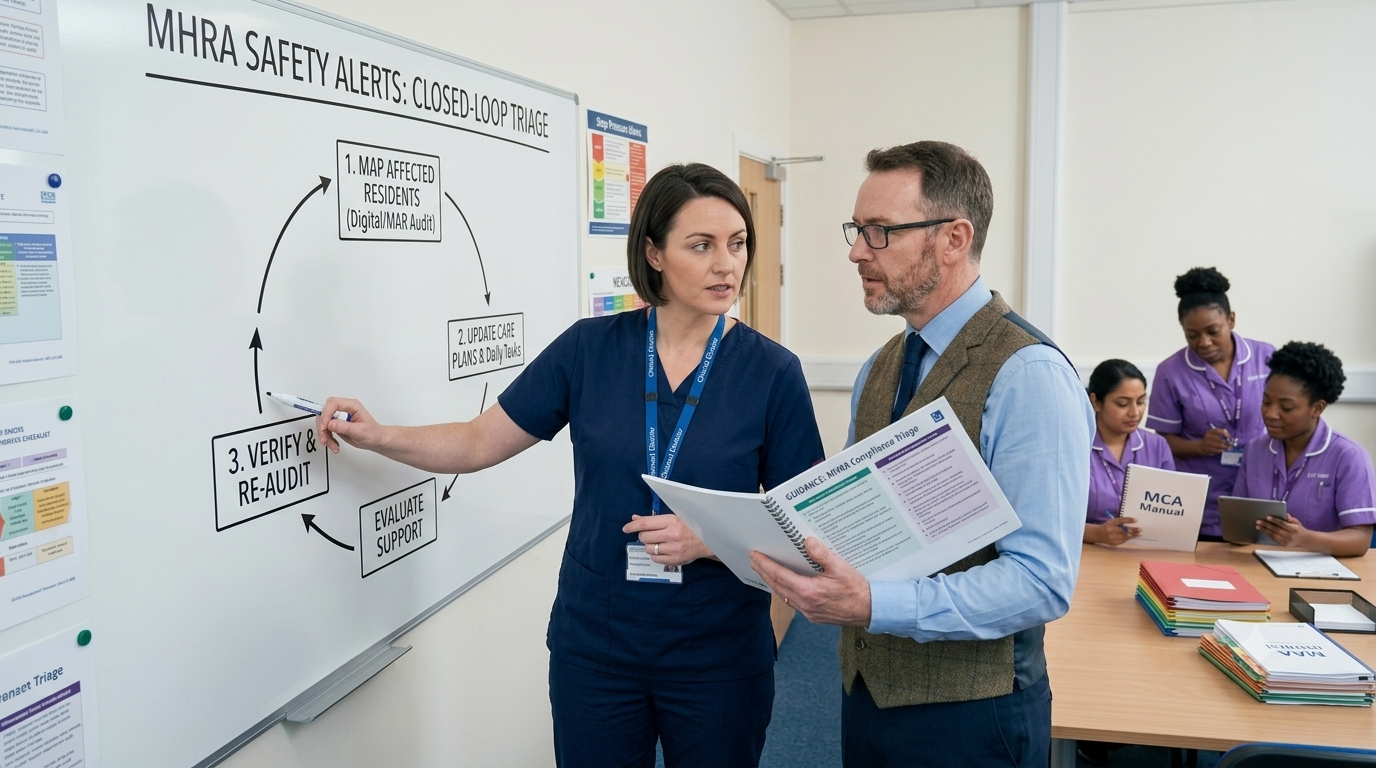
Building an Action-Oriented Safety Alert Framework To ensure watertight governance, clinical educators must train Unit Leads and Senior Carers to manage incoming alerts through a dynamic three-tier response:
- 1. Immediate Identification & Resident Mapping: Upon receipt of an MHRA alert, conduct an immediate digital or MAR sheet audit to identify every affected resident. Document this specific list directly within your safety log.
- 2. Clinical Action & Care Plan Integration: Update individual care plans instantly. If monitoring parameters change (e.g., increased blood pressure checks or revised side-effect tracking), ensure these are embedded directly into daily care tasks rather than left as verbal handover notes.
- 3. Verification & Re-Audit: Conduct a closed-loop spot check 14 days after implementing the change to verify that floor staff are adhering to the updated safety protocol in practice.
Upskilling Your Senior Leads Effective risk management should never rely solely on the Registered Manager's inbox. Training your clinical leads and senior care staff to take ownership of safety alert triage creates a culture of continuous vigilance. When your floor leads can confidently walk an inspector through how an MHRA alert was received, mapped, actioned, and re-audited, you demonstrate the highest standards of clinical leadership and regulatory compliance.