
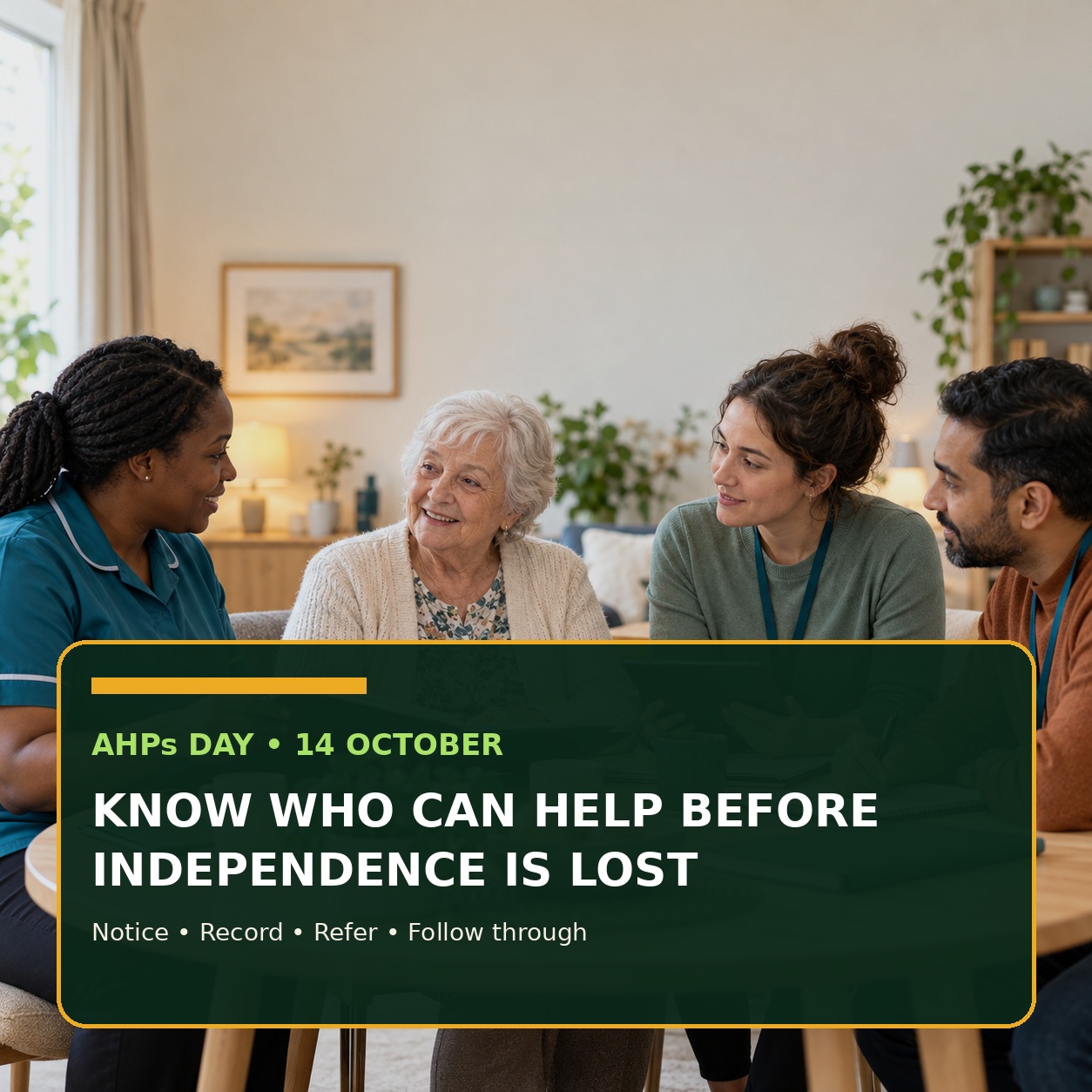
Know Who Can Help Before Independence Is Lost
Wednesday 14 October 2026 is AHPs Day. This year’s national theme, “Celebrating AHPs Deliver”, recognises the contribution allied health professionals make across health and care. For adult social care teams, it is also a useful prompt: when a person’s abilities or needs change, do we know which professional might help—and do we follow the concern through?
Allied health professionals, often shortened to AHPs, are the third-largest clinical workforce in health and care. England recognises 14 AHP professions. They include occupational therapists, physiotherapists, speech and language therapists, dietitians, podiatrists and paramedics, as well as art, drama and music therapists, operating department practitioners, orthoptists, osteopaths, prosthetists and orthotists, and radiographers.
Care workers do not need to diagnose a condition or select a treatment. Their contribution is different and essential: notice a meaningful change, record it clearly, raise it through the agreed route, and help the person and wider team follow through.
NOTICE: start with what has changed
A referral is stronger when it starts with observable facts rather than assumptions. “She is deteriorating” gives very little information. “Over the last four mornings, Joan has needed two attempts to stand from her usual chair and has stopped walking to the dining room” tells the team what changed, when it changed and how daily life is affected.
Look for change in areas such as:
- getting washed, dressed, preparing food or managing other everyday tasks;
- walking, transfers, balance, strength, pain or confidence in movement;
- speaking, understanding, expressing choices or using usual communication aids;
- eating, drinking, swallowing, appetite, weight or hydration;
- foot or lower-limb pain, skin condition, footwear or mobility;
- repeated urgent episodes, new frailty or a change that may need timely clinical assessment.
Ask what the person has noticed and what matters to them. A change is not only significant when it creates immediate physical risk. Being unable to make tea, use the garden, speak on the telephone or reach the bathroom independently can affect identity, confidence and quality of life.
RECORD: describe function, context and impact
Objective recording helps the next professional understand the concern. Include:
- what happened and what the person said;
- the date, time, setting and activity;
- what is different from the person’s usual presentation;
- any immediate action taken under the care plan;
- the effect on safety, comfort, communication, nutrition or independence;
- who was informed and what follow-up was agreed.
Avoid diagnosing or using vague labels. Record “coughed twice after the first sip and developed a wet-sounding voice” rather than deciding that the person “has dysphagia”. Record “new redness over the heel” rather than predicting its cause. Clear observations allow registered professionals to assess within their scope.
REFER: match the concern to the right expertise
Local access routes differ. A care worker may need to report to a senior, registered manager, nurse, GP, community team or multidisciplinary meeting rather than contact an AHP directly. Follow the organisation’s policy, care plan and urgent-escalation arrangements.
Occupational therapists
Occupational therapists help people do the activities they need or want to do in everyday life. Their input may be useful when a person is struggling with washing, dressing, preparing food, using the toilet, getting around their home or taking part in valued routines. An OT may explore the task, environment, equipment, habits and the person’s own goals. Equipment should be assessed, supplied and used as instructed; improvised solutions can create new risks.
Physiotherapists
Physiotherapists support people affected by illness, injury, disability or frailty through movement, exercise, advice and other interventions. Consider the agreed pathway when there is a meaningful change in walking, transfers, strength, balance, posture, pain or recovery. Care staff should not invent exercises or alter mobility techniques independently. Continue to use the person’s current plan unless urgent circumstances or an authorised review changes it.
Speech and language therapists
Speech and language therapists support people with communication and with eating, drinking and swallowing difficulties. Their expertise may be relevant when someone develops new difficulty expressing needs, understanding information, using a communication aid, managing food or drink, or following an existing swallowing plan. New choking, breathing difficulty or acute illness may be an emergency: use the organisation’s emergency procedure. Do not trial unapproved textures, fluids or techniques while waiting for advice.
Dietitians
Dietitians translate nutrition science into practical, individual advice. Unplanned weight change, poor intake, complex dietary needs, persistent nutrition concerns or the need for specialist nutritional support may require dietetic input through the agreed pathway. Record intake and weight only as the person’s plan and local policy require. Food fortification, supplements and restrictions should not be introduced casually; they may be unsuitable for some people.
Podiatrists
Podiatrists assess and treat conditions affecting feet and lower limbs. Foot pain, wounds, changes to skin or nails, altered gait and difficulty with footwear can quickly affect mobility and independence. People living with diabetes or poor circulation may require particularly prompt action under their care plan. Care workers should stay within their training and not cut nails, treat lesions or use products unless authorised and competent to do so.
Paramedics
Paramedics are well known for emergency pre-hospital care, but they also work in community, urgent, primary and secondary care. Depending on local services, they may assess and treat people at home or support decisions about the most appropriate next step. Their inclusion among AHPs does not replace emergency procedures: when a person is seriously ill or there is an immediate threat to life, call emergency services in line with policy.
FOLLOW THROUGH: referral is only the beginning
Good care does not end when a form is submitted or a message is passed on. Follow-through protects the person from being lost between services.
Check that the concern reached the right person. Record the response and any expected timescale. Make sure new professional advice is communicated to everyone who supports the person, incorporated into the care plan where appropriate, and understood by the person in an accessible way. Check that equipment arrives, appointments are supported, recommendations are put into practice by competent staff, and the outcome is reviewed.
If the person’s condition worsens while waiting, reassess the urgency and use the escalation route again. If advice is not workable in the real care setting, feed that back rather than allowing it to drift. The person should remain part of decisions throughout; a referral is not permission to take over.
A simple practice prompt
NOTICE → RECORD → REFER → FOLLOW THROUGH
Notice the functional change. Record objective detail. Refer or escalate through the agreed local pathway. Follow through with the person until there is a clear outcome.
AHPs Day celebrates a broad and skilled workforce. In adult social care, the celebration becomes practical when teams recognise the right expertise early and connect it to what matters in the person’s life.
The right professional, at the right time, can protect independence.
Practice note: This article supports reflection and training. It does not replace individual assessment, organisational policy, local referral criteria, a person’s care plan or emergency procedures.
Sources
NHS England, Allied health professions (AHPs) day; Allied health professions; AHPs Deliver.
Health and Care Professions Council, Which professions do HCPC regulate? and How to check the Register.