
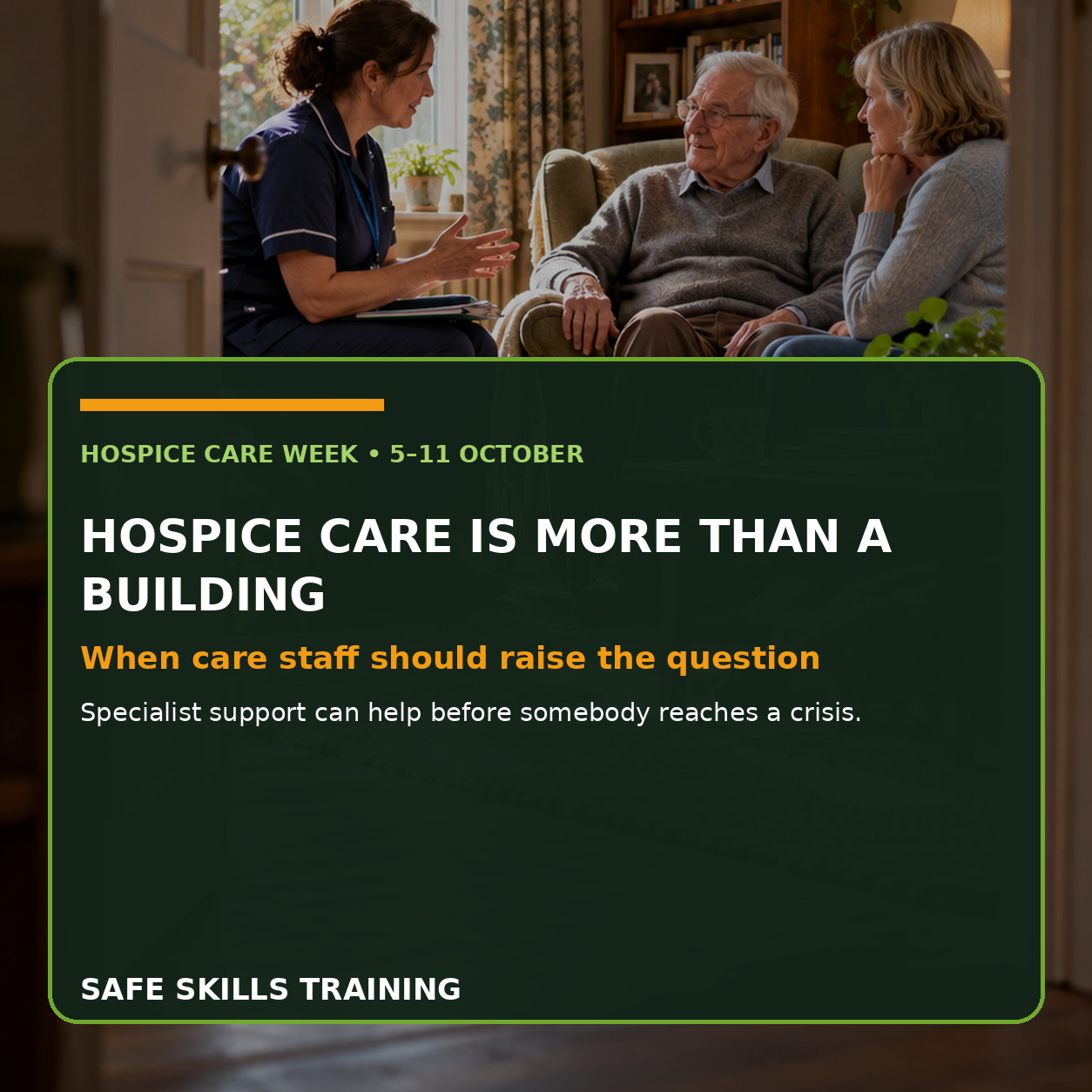
Hospice Care Week: hospice care is more than a building
Why care staff should recognise when specialist support could help—before someone reaches a crisis
Hospice Care Week runs from 5 to 11 October 2026. This year’s Hospice UK theme is “Don’t leave hospice care to chance.”
That message matters in adult social care because hospice involvement is still widely misunderstood. Some people hear the word “hospice” and assume it means moving into a particular building for the final days of life. Others believe accepting hospice support means stopping treatment or giving up hope.
Hospice care can be much broader. It may begin at any stage of a life-limiting condition, alongside other treatment, and may be delivered in the person’s own home, a care home, through day services or during a short specialist admission.
Good hospice care is active care. Its purpose is to improve quality of life and wellbeing for the person while also supporting those important to them.
HOSPICE CARE IS NOT ONLY FOR CANCER
Hospice services support people with many different life-limiting conditions. These can include:
- cancer
- heart failure and other advanced cardiac disease
- chronic obstructive pulmonary disease and other respiratory disease
- motor neurone disease and other neurological conditions
- advanced kidney or liver disease
- dementia and complex frailty
- multiple conditions that together limit life and cause significant needs
Eligibility and available services vary locally. A diagnosis alone does not automatically determine whether a hospice will become involved. Referral is based on the person’s needs, the service’s criteria and what specialist support may add.
HOSPICE CARE IS NOT ONLY A BUILDING
Hospice support may be delivered:
- in the person’s own home
- within a residential or nursing home
- through outpatient or day services
- by telephone or virtual support
- during a short inpatient stay for symptom assessment or stabilisation
- during the final stage of life when inpatient care is appropriate
Some people receive specialist hospice input and never stay in a hospice building. Others may be admitted briefly and then return home or to their care setting.
WHAT CAN HOSPICE AND PALLIATIVE TEAMS HELP WITH?
Services differ, but support may include:
- complex pain and symptom management
- breathlessness, nausea, fatigue or anxiety
- emotional, psychological and spiritual support
- advance-care planning and conversations about preferences
- practical advice and occupational therapy
- support for relatives and other carers
- coordination with GPs, community nurses and care services
- respite, day services or short admissions
- support during dying and bereavement services
The focus is not simply on how long somebody may live. It is also on comfort, autonomy, relationships, meaningful activity and helping the person live as well as possible.
SUPPORT DOES NOT HAVE TO WAIT FOR THE FINAL DAYS
Hospice UK states that hospice care can be provided at any stage of a life-limiting condition. NHS guidance also explains that hospice teams may help control symptoms such as pain or breathlessness earlier in an illness, sometimes through a short admission followed by a return home.
Earlier involvement can provide time to understand the person’s priorities, improve difficult symptoms, support family members and plan what should happen if the condition changes.
Waiting until somebody is actively dying may mean that opportunities for this wider support have been missed.
WHEN SHOULD CARE STAFF RAISE THE QUESTION?
Care staff do not diagnose somebody as approaching the end of life and should not promise that a hospice referral will be accepted. They are, however, often the people who notice gradual change first.
It may be appropriate to request clinical review when staff observe:
- pain, breathlessness, nausea, agitation, anxiety or other symptoms that remain difficult to control
- repeated episodes of deterioration or crisis
- increasing emergency calls, out-of-hours contacts or hospital admissions
- worsening mobility, communication, appetite, fatigue or participation
- increasing dependence or difficulty recovering after illness
- distress about the future or uncertainty about preferences
- family members or other carers struggling to cope
- disagreement or confusion about the goals of treatment and care
- an advance-care plan that is absent, incomplete or no longer reflects the person’s wishes
A single sign does not automatically mean hospice care is required. The pattern, impact and person’s own priorities should be shared with the appropriate clinician.
NOTICE, RECORD, DISCUSS AND REQUEST REVIEW
- NOTICE
Recognise changes from the person’s usual condition, including symptoms, function, mood, communication and support needs.
- RECORD
Document what has changed, when it began, how often it occurs, what makes it better or worse and how it affects the person. Avoid vague phrases such as “generally declining” without supporting detail.
- DISCUSS
Listen to the person. Ask what matters to them, what they are finding difficult and whether they would welcome more support. Include relatives or representatives appropriately, while respecting consent, confidentiality and mental-capacity requirements.
- REQUEST REVIEW
Raise the concern through the person’s agreed pathway. This may involve the GP, community nurse, specialist nurse, hospital team or an existing palliative-care service. The clinician can consider whether referral, symptom review or advance-care planning is appropriate.
- REVIEW
Follow the agreed plan, continue observing the person and report further change. Confirm that instructions, contact numbers and escalation arrangements are accessible to everyone providing care.
HOSPICE CARE DOES NOT REPLACE URGENT ASSESSMENT
Not every deterioration is an expected part of a life-limiting illness. New symptoms may have a reversible cause and still require assessment and treatment.
Do not allow a possible hospice or palliative-care need to delay an urgent response. Follow the person’s care plan and local escalation pathway. Call 999 for life-threatening deterioration unless a valid, applicable individual plan directs otherwise and staff are authorised to follow it.
ADVANCE-CARE PLANNING IS A CONVERSATION
NICE recommends that adults approaching the end of life are offered opportunities to discuss advance-care planning. This should not be reduced to completing a form or making assumptions about resuscitation.
Depending on the person’s wishes and circumstances, discussions may include:
- what matters most to them
- where they would prefer to receive care
- who they want involved in decisions
- cultural, religious, social or spiritual needs
- treatments they would or would not want
- symptom-control planning
- who should be contacted when their condition changes
The person may choose not to discuss some or all of these matters. Conversations should happen sensitively, at an appropriate pace and with communication support where needed.
SUPPORTING THOSE CLOSE TO THE PERSON
Relatives and friends may provide substantial physical and emotional care. They may also be frightened by changing symptoms, exhausted or uncertain about whom to contact.
Hospice and palliative-care services may offer practical guidance, emotional support, respite or bereavement services. Care staff should record concerns expressed by carers and ensure these are shared through the agreed professional route.
THE PRACTICAL MESSAGE FOR HOSPICE CARE WEEK
Hospice support is not a sign that nothing more can be done. It can mean doing more for comfort, choice, communication, family support and quality of life.
Care staff do not decide whether somebody needs hospice care. They do something equally important: notice change, document it clearly, listen to the person and ensure the right professional is asked to review the need.
Do not wait for a crisis to ask whether specialist support could help.
Safe Skills Training provides practical clinical-skills, first-aid, moving-and-handling and patient-safety training for adult-social-care teams. To discuss training for your organisation, visit www.safeskillstraining.com.
GUIDANCE AND SOURCES
Hospice UK: Hospice Care Week 2026
https://www.hospiceuk.org/our-campaigns/hospice-care-week
Hospice UK: What is hospice care?
https://www.hospiceuk.org/information-and-support/your-guide-hospice-and-end-life-care/im-looking-hospice-care/what-hospice
Hospice UK: What services does a hospice offer?
https://www.hospiceuk.org/information-and-support/your-guide-hospice-and-end-life-care/im-looking-hospice-care/what-services
NHS: Hospice care
https://www.nhs.uk/tests-and-treatments/end-of-life-care/where-you-can-have-care/hospice-care/
NHS: What end-of-life care involves
https://www.nhs.uk/tests-and-treatments/end-of-life-care/what-it-involves-and-when-it-starts/
NICE: End of life care for adults—service delivery (NG142)
https://www.nice.org.uk/guidance/ng142/chapter/recommendations
NICE: End of life care for adults—advance care planning (QS13)
https://www.nice.org.uk/guidance/qs13/chapter/Quality-statement-2-Advance-care-planning