
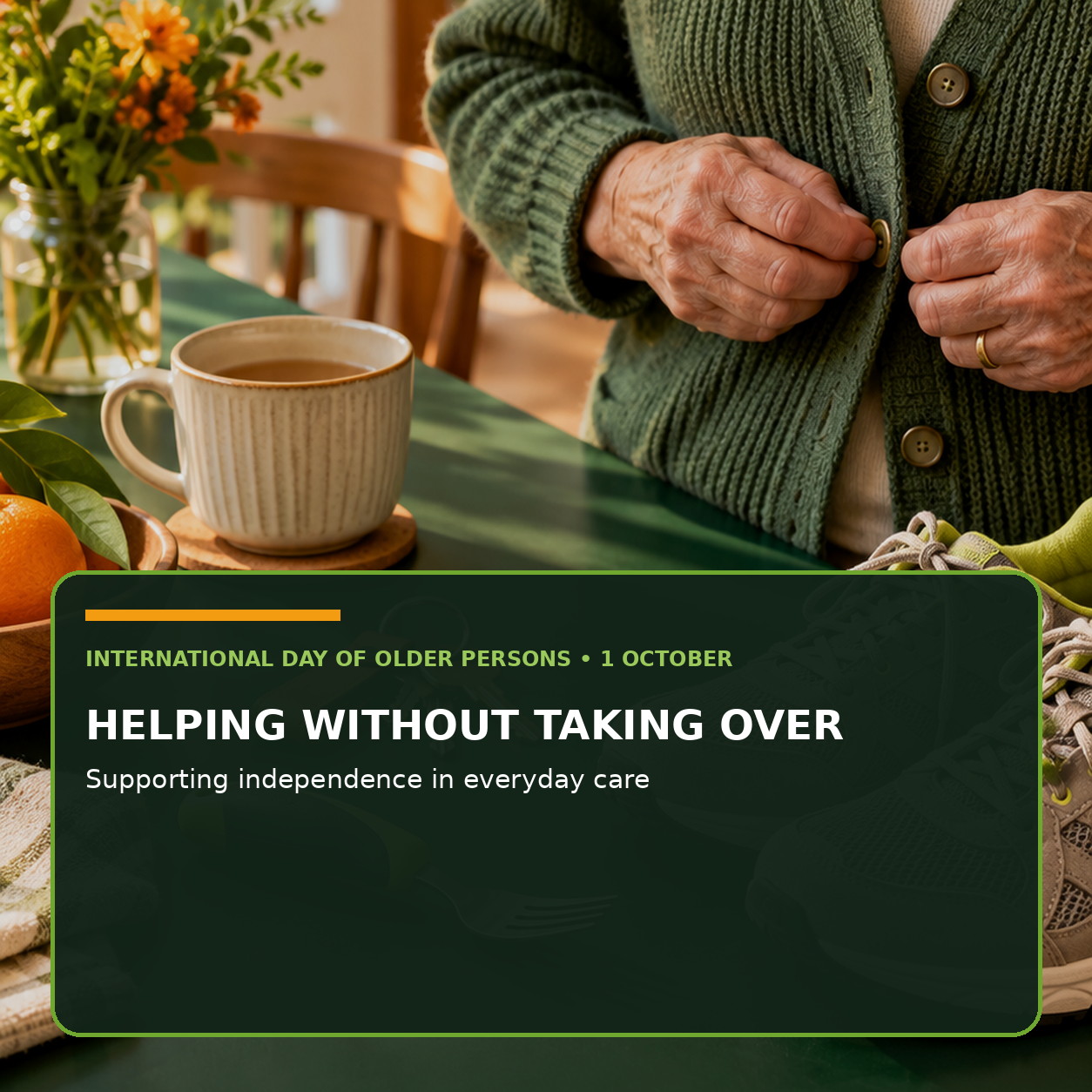
Helping without taking over: supporting independence in everyday care
The United Nations marks 1 October as the International Day of Older Persons. The 2026 theme—“The Age of Longevity: Rethinking Systems for Longer Lives”—invites us to consider not only how long people live, but how care systems protect autonomy, purpose and participation throughout later life.
In adult social care, support is often judged by whether the task was completed: was the person washed, dressed, fed, moved or ready on time?
Completion matters. But there is another important question:
How much of the task was the person enabled to do for themselves?
Good care does not automatically mean doing more. Sometimes it means asking, waiting, prompting, adapting the environment and then providing only the assistance the person actually needs.
This is not about withdrawing support or leaving somebody to struggle. It is about protecting ability, confidence, choice and control while providing safe, proportionate help.
WHY HELPING TOO MUCH CAN CAUSE HARM
Taking over can feel caring, efficient and risk-free. It may also be necessary when somebody is acutely unwell, fatigued, distressed or unable to complete a task safely.
However, routinely doing everything for a person can gradually reduce opportunities to:
- move, reach, grip and balance
- practise familiar skills
- make everyday decisions
- maintain confidence
- communicate preferences
- experience purpose and achievement
- notice changes in ability
Skills and confidence that are not used can be lost. The person may become increasingly dependent—not because their underlying condition required it, but because the care routine stopped giving them opportunities to participate.
The answer is not to make every task into a test or rehabilitation exercise. It is to recognise the small, ordinary opportunities that matter to that individual.
INDEPENDENCE IS PERSONAL
Independence does not mean completing everything alone.
For one person, independence may mean making the whole drink. For another, it may mean choosing the cup, holding it with adapted equipment or adding their own sugar after somebody else safely handles the kettle.
For one person, dressing independently may mean selecting clothes and managing every fastener. For another, it may mean putting one arm into a sleeve, fastening the buttons they can reach or directing the order in which support is provided.
The outcome should be meaningful to the person—not based on what staff think they ought to achieve.
START BY ASKING
Before stepping in, ask:
- What would you like to do yourself?
- How do you usually manage this?
- What would make it easier?
- Would you like a prompt, some equipment or physical help?
- Is today different from usual?
Do not assume that somebody wants help merely because a task is slow, unconventional or imperfect.
Consent applies to everyday care. Explain what support you are offering and obtain permission before touching the person, moving their belongings or taking over an activity.
USE GRADED SUPPORT
A useful sequence is:
- ASK — Find out what the person wants to do and what help they would like.
- WAIT — Allow enough processing and response time.
- PROMPT — Offer a verbal, visual or gestural cue if helpful.
- ADAPT — Adjust the environment, positioning, equipment or task.
- ASSIST — Provide the minimum physical help required for safe completion.
The sequence is not a rigid ladder. The appropriate starting point depends on the person, the activity, their care plan and how they are that day.
Somebody may need full help with one part of a task and no help with another. Support should respond to actual need, not be delivered as one standard package.
ALLOW TIME WITHOUT CREATING PRESSURE
Time pressure is real. Care workers have schedules, competing needs and unexpected events. Nevertheless, always taking over because it is faster can create greater dependence and more care needs over time.
Managers can support enabling care by:
- planning realistic visit and task times
- recording what the person can do—not only what staff must do
- making equipment readily available
- ensuring staff understand consistent prompts and techniques
- avoiding routines that value speed above outcomes
- reviewing repeated reports that staff “do not have time” to support participation
Staff should never blame or rush the person for taking longer. Encouragement should feel supportive, not like pressure to perform.
BREAK THE ACTIVITY INTO MEANINGFUL PARTS
A person may not be able to complete a whole activity but may still participate in parts of it.
Examples include:
Personal care
- choosing products, water temperature or clothing
- washing the areas they can reach
- brushing their own teeth with equipment or prompting
- directing the order and manner in which support is given
Dressing
- choosing clothes
- putting arms through sleeves
- managing larger fasteners
- using a button hook, dressing stick or other assessed aid
Food and drink
- selecting between safe options
- opening packaging or adding ingredients
- using adapted crockery or cutlery
- eating or drinking independently with the positioning and supervision identified in the care plan
Mobility
- completing the parts of a transfer they are assessed to undertake
- walking the distance identified in the care plan
- reaching for and using their own walking aid
- taking part in prescribed exercises or daily movement
Medication
- participating in decisions and understanding what medicines are for
- self-administering where this has been assessed and agreed
- using suitable prompts, packaging or secure storage under the care plan
Never improvise moving-and-handling techniques, swallowing support or medication arrangements. Follow the current assessment, care plan and staff training.
ADAPT THE TASK—NOT THE PERSON’S RIGHTS
Small environmental changes can make participation possible:
- placing items within safe reach
- improving lighting and contrast
- reducing clutter and distraction
- providing a stable chair or surface
- using non-slip materials
- checking that glasses and hearing aids are available
- using pictures, signs or the person’s communication aid
- arranging occupational-therapy assessment for suitable equipment
Equipment must be appropriate, maintained and used as assessed. A gadget is not enabling if the person cannot use it safely or does not want it.
BALANCE RISK WITH BENEFIT
Eliminating every possibility of failure, spillage or minor difficulty can also eliminate choice and participation.
NICE advises balancing the risk of an activity against how it may benefit wellbeing and quality of life. CQC expects people to have as much independence, choice and control as possible, with person-centred and proportionate risk management.
Useful questions include:
- What does the person want to achieve?
- What are the actual hazards—not simply the feared outcome?
- What could reduce the risk without removing the activity?
- What is the benefit to confidence, function, identity or wellbeing?
- Has the person been involved in the risk assessment?
- Is the restriction the least restrictive workable option?
Positive risk enablement does not mean ignoring serious hazards. It means making a reasoned, person-centred decision rather than imposing blanket restrictions.
MENTAL CAPACITY AND EVERYDAY CHOICE
Capacity is decision-specific and time-specific. Do not assume that age, diagnosis, dementia, communication difficulty or an unwise decision means somebody lacks capacity.
The Mental Capacity Act requires people to receive practical support to make their own decisions wherever possible. When a person lacks capacity for a particular decision, any decision made on their behalf must be in their best interests and use the least restrictive effective option.
Record the support used to help the person decide. Involve appropriate representatives and follow the organisation’s Mental Capacity Act procedures where a formal assessment or best-interests decision is required.
NOTICE AND REPORT CHANGES
Enabling somebody to participate also helps staff notice deterioration.
If a person who normally buttons their cardigan, holds a cup or walks to the bathroom suddenly cannot do so, do not quietly increase assistance and move on.
Consider:
- when the change began
- whether it was sudden or gradual
- pain, weakness, dizziness, confusion or breathlessness
- recent illness, injury, fall or medication change
- food and fluid intake
- whether one side appears weaker
- changes from the person’s normal communication or behaviour
Follow the person’s deterioration and escalation plan. Use RESTORE2 or another approved system where this forms part of local practice. Sudden facial weakness, arm weakness or speech disturbance requires immediate stroke action using FAST and 999.
RECORD ABILITY AS WELL AS NEED
Care records should state clearly:
- what the person can do independently
- what they want to continue doing
- the prompt, adaptation or equipment that helps
- which parts require supervision or physical assistance
- relevant risks and agreed control measures
- signs that indicate the person is becoming tired or unwell
- what staff should do if ability changes
Avoid vague instructions such as “assist with dressing” when different staff could interpret them differently.
A clearer entry might be:
“Mrs B chooses her clothes and dresses her upper body when items are laid out in order. Allow time and offer one verbal prompt if she pauses. She needs physical assistance with compression hosiery. Report new difficulty using her right hand.”
REVIEW BOTH IMPROVEMENT AND DECLINE
Care plans should change when the person changes.
If ability improves after illness, rehabilitation or equipment provision, reduce assistance appropriately and celebrate progress. If ability declines, investigate why and arrange review rather than allowing increased dependence to become the undocumented new normal.
Involve the person, family or advocate, relevant health professionals and the wider care team. Consistent support helps prevent one worker encouraging independence while another automatically takes over.
THE PRACTICAL MESSAGE
Good care is not measured only by how many tasks staff complete.
Before taking over, ask what the person can do, what they want to do and what would make participation easier. Allow time, use graded support and provide the minimum assistance needed for safety and dignity.
Supporting independence does not mean leaving somebody unsupported. It means supporting the person—not just completing the task.
Safe Skills Training provides practical clinical-skills, mandatory and patient-safety training for adult-social-care teams. To discuss training for your service, visit www.safeskillstraining.com.
GUIDANCE AND FURTHER INFORMATION
United Nations: International Day of Older Persons
https://www.un.org/en/observances/older-persons-day
CQC: Independence, choice and control
https://www.cqc.org.uk/guidance-regulation/providers/assessment/single-assessment-framework/caring/independence-choice-control
CQC: Regulation 9—Person-centred care
https://www.cqc.org.uk/guidance-regulation/providers/regulations-service-providers-and-managers/health-social-care-act/regulation-9
NICE: Home care—delivering personal care and practical support to older people
https://www.nice.org.uk/guidance/ng21/chapter/recommendations
NICE: Participation in meaningful activity
https://www.nice.org.uk/guidance/qs50/chapter/Quality-statement-1-Participation-in-meaningful-activity
GOV.UK: Mental Capacity Act Code of Practice
https://www.gov.uk/government/publications/mental-capacity-act-code-of-practice
SCIE: Role and principles of reablement
https://www.scie.org.uk/integrated-care/intermediate-care-reablement/role-and-principles-of-reablement/