
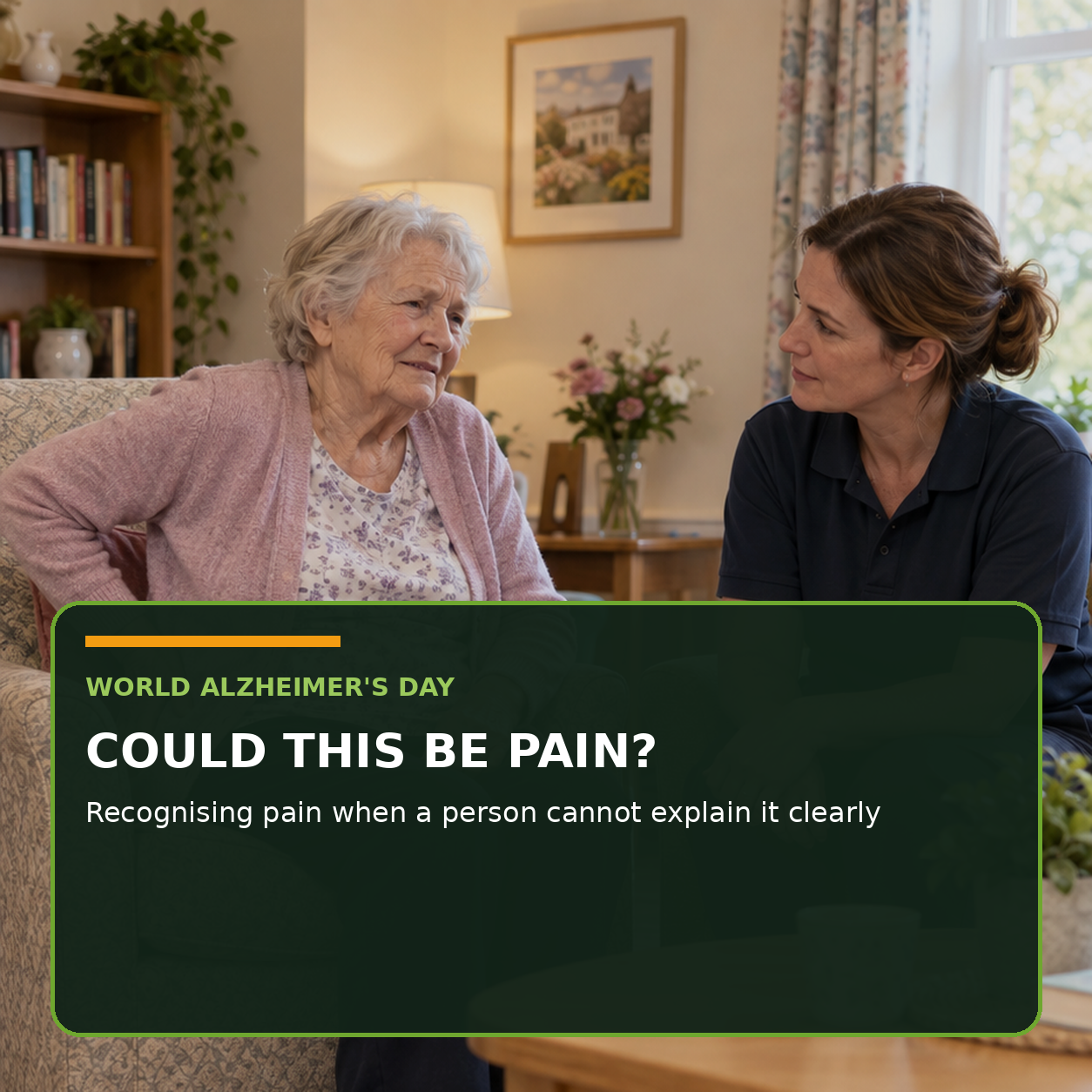
Could pain be behind a change in behaviour?
World Alzheimer’s Day takes place on Monday 21 September. It is an opportunity to challenge stigma and improve the everyday support received by people living with Alzheimer’s disease and other types of dementia.
One important patient-safety issue is pain. A person living with dementia may still be able to describe pain clearly, and staff should never assume otherwise. However, changes in memory, language, perception or communication can sometimes make it difficult to explain where something hurts, how severe it is or when it began.
Pain does not disappear because a person cannot describe it. It may instead be communicated through a change in expression, movement, engagement, sleep, appetite or behaviour.
The safest response is not to label the change. It is to ask what the person may be communicating and investigate respectfully.
START WITH THE PERSON
Self-report remains important whenever possible. Speak directly to the person, allow time for an answer and use the communication approach that works best for them.
Depending upon the individual, this may involve:
- short, concrete questions
- familiar words for pain or discomfort
- asking one question at a time
- gestures, pictures or a recognised pain scale
- showing or pointing to a body area
- information in the person’s communication passport or care plan
- support from somebody who knows the person well
Avoid repeatedly asking complex questions or assuming that an inconsistent answer means the person is not experiencing pain. Check hearing, vision, language and communication needs, and reduce avoidable noise or distraction.
WHAT CHANGES MIGHT STAFF NOTICE?
Pain can look different from one person to another. The most useful clue may be a change from the person’s normal presentation.
Possible signs include:
- grimacing, frowning, tightened facial muscles or looking frightened
- guarding, rubbing or protecting part of the body
- stiffness, limping or reluctance to stand, walk or change position
- flinching during movement, personal care or dressing
- calling out, groaning, crying or becoming unusually quiet
- withdrawal from conversation, activity or touch
- reduced appetite or reluctance to eat and drink
- disrupted sleep or increased restlessness
- resistance to care that is normally accepted
- a sudden change in mood, engagement or behaviour
These observations do not prove that pain is present, and they do not identify the cause. They are signals that the person needs further assessment rather than a behavioural label.
LOOK FOR A POSSIBLE CAUSE
Consider what has changed and when it began. Review recent events, records and handovers, and follow the person’s care plan.
Possible causes may include:
- a recent fall, knock, wound or other injury
- arthritis, muscle pain or discomfort during movement
- constipation or urinary retention
- urinary symptoms or another infection
- dental pain, mouth soreness or poorly fitting dentures
- pressure damage, skin irritation or an uncomfortable dressing
- poor positioning, unsuitable footwear or equipment
- headache, abdominal pain or another new health problem
- a procedure, treatment or known long-term condition
Do not assume that distress is “just dementia”. Equally, do not assume that every change is pain. Delirium, infection, medication effects, hunger, thirst, fatigue, fear, sensory overload and unmet emotional needs may produce similar changes and may need urgent assessment.
USE AN APPROVED OBSERVATIONAL PAIN TOOL
NICE recommends considering a structured observational pain-assessment tool alongside self-reported pain and standard clinical assessment for people with moderate-to-severe dementia, and alongside clinical assessment when a person cannot self-report pain.
Services may use tools such as the Abbey Pain Scale or PAINAD, but staff should use only the tool adopted by their organisation and for which they have received appropriate instruction. A score supports structured observation; it does not diagnose the cause of pain or replace professional judgement.
Observational assessment may consider areas such as:
- vocalisation
- facial expression
- body movement and guarding
- changes in interaction or activity
- changes in mental state
- physiological changes where appropriate
Where possible, compare findings with the person’s baseline and involve family members or regular staff who understand their usual communication. Record specific observations rather than writing only “agitated” or “challenging”.
For example: “Usually walks to lunch independently. Today stopped after two steps, held the right knee, grimaced and said ‘no’ when asked to continue.” This gives the next person useful clinical information.
RESPOND, RECORD AND REASSESS
Follow the person’s care plan and organisational policy. Immediate supportive actions may include helping the person into a more comfortable position, reducing environmental stress, checking clothing or equipment, offering reassurance and seeking the appropriate clinical review.
Pain medicines must be administered only as prescribed and by staff who are trained, competent and authorised to do so. A PRN medicine still requires a clear reason, safe dose and interval, appropriate checks, accurate recording and review of its effect.
NICE advises repeating pain assessment when a person appears to be in pain, when behavioural change may be caused by pain and after any pain-management intervention.
Record:
- the change and when it began
- what the person said or communicated
- specific signs observed
- the assessment tool and score, where used
- possible triggers or causes considered
- actions or medicines provided
- who was contacted and the advice received
- the person’s response
- when reassessment or further escalation is required
If an intervention appears to help, this is useful information—but improvement alone does not confirm the cause. The person may still require assessment, treatment or a care-plan review.
ESCALATE CLEARLY WITH SBARD
Use the service’s agreed escalation route. SBARD can help staff communicate a concern clearly:
Situation — Who are you concerned about, and what is happening now?
Background — What relevant diagnosis, history, recent event, medicine or known pain problem should the clinician know?
Assessment — What has changed from the person’s baseline? Include their communication, observed signs, pain score where used, relevant observations and actions already taken.
Recommendation — What review, advice or action is needed?
Decision — Record what was agreed, who will do it, the timescale, monitoring instructions and when to escalate again.
SBARD structures the information; it must never delay an emergency response.
WHEN IS URGENT HELP NEEDED?
Follow the person’s emergency plan and organisational policy. Call 999 for a life-threatening emergency, including severe breathing difficulty, suspected heart attack or stroke, collapse, major trauma or another immediately serious condition.
Seek urgent clinical advice for concerns such as sudden severe or unexplained pain, a suspected fracture, significant pain after a fall, a rigid or severely painful abdomen, new neurological changes, rapidly worsening symptoms or pain that cannot be safely managed through the existing plan.
If staff are unsure whether the situation is an emergency, they should explain the concern clearly and seek advice without avoidable delay. A completed observational tool must not become a reason to wait when the person appears seriously unwell.
BEFORE CALLING IT “BEHAVIOUR”…
Ask:
- What exactly has changed from this person’s normal presentation?
- Have we asked and supported them to communicate in a way that works for them?
- Could pain, illness, fear or another unmet need explain the change?
- Have we used the service’s approved assessment process?
- Have we recorded, escalated and reassessed the concern?
Good dementia care is curious, respectful and person-centred. The aim is not simply to stop a behaviour. It is to understand what the person may be communicating and respond to the need behind it.
Safe Skills Training provides practical clinical-skills, medicines and patient-safety training for adult social-care teams. To discuss training for your service, visit www.safeskillstraining.com.
GUIDANCE AND FURTHER INFORMATION
Alzheimer’s Disease International: World Alzheimer’s Month
https://www.alzint.org/get-involved/world-alzheimers-month/
NICE NG97: Dementia—assessment, management and support
https://www.nice.org.uk/guidance/ng97/chapter/recommendations
NHS England: Managing acute physical deterioration through the PIER approach
https://www.england.nhs.uk/patient-safety/managing-acute-physical-deterioration-through-the-prevention-identification-escalation-response-pier-approach/
Care Quality Commission: Regulation 9—Person-centred care
https://www.cqc.org.uk/guidance-regulation/providers/regulations-service-providers-and-managers/health-social-care-act/regulation-9
Care Quality Commission: Regulation 12—Safe care and treatment
https://www.cqc.org.uk/guidance-regulation/providers/regulations-service-providers-and-managers/health-social-care-act/regulation-12