
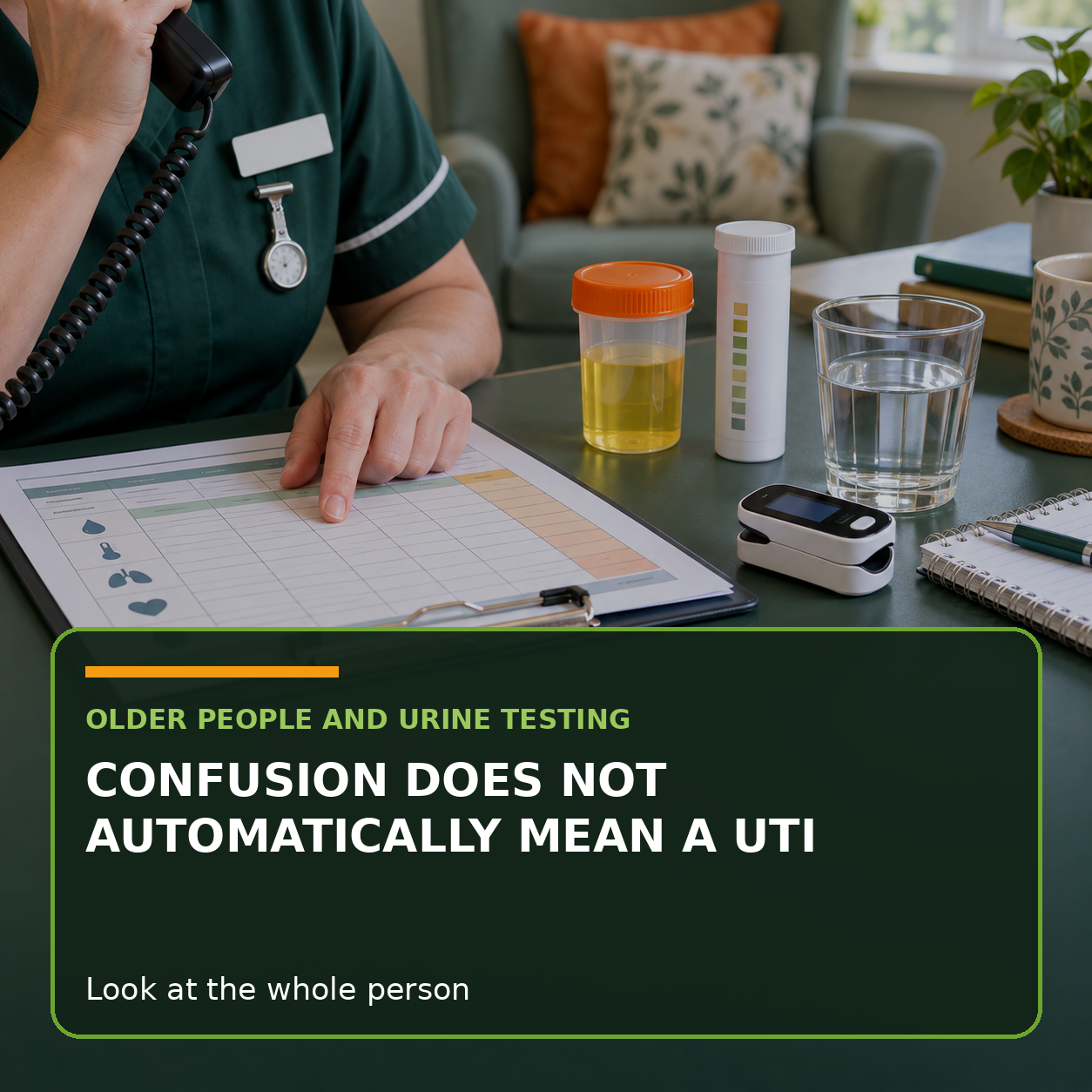
Confusion does not automatically mean a UTI
When an older person becomes suddenly confused, “It could be a urine infection” is often one of the first suggestions made in a care setting.
A urinary tract infection is one possibility—but confusion alone does not confirm it. Automatically labelling every change as a UTI can delay recognition of dehydration, constipation, pain, medication effects, low oxygen levels, another infection, stroke or other acute deterioration.
The safer approach is to assess the whole person, document what has changed and communicate concerns clearly.
WHY ARE URINE DIPSTICKS UNRELIABLE IN PEOPLE OVER 65?
Bacteria may be present in an older person’s urine without causing illness. This is called asymptomatic bacteriuria, and it becomes increasingly common with age and catheter use.
A urine dipstick may react to bacteria or white blood cells that are present even though the person does not have a symptomatic UTI. The result can therefore encourage unnecessary antibiotics while the true cause of illness remains untreated.
Current UKHSA guidance advises against using urine dipsticks to diagnose UTI in adults over 65. The NHS England “To Dip or Not to Dip” approach reinforces this message for care homes.
This does not mean ignoring possible UTI. It means basing assessment and escalation on the person’s symptoms and clinical condition—not on a strip alone.
WHAT SHOULD CARE STAFF LOOK FOR?
Record what is new or different from the person’s normal presentation. Relevant urinary features may include:
- new pain or burning when passing urine
- new urinary urgency or frequency
- new or noticeably increased incontinence
- new suprapubic discomfort
- new loin or flank pain
- visible blood in the urine
- fever, shivering or rigors
Cloudy or strong-smelling urine on its own does not prove a UTI. It may occur with concentrated urine, dehydration, diet, medicines or colonisation.
If the person has a urinary catheter, cloudy urine, sediment or a positive dipstick alone should not be treated as proof of infection. Follow the person’s catheter-care plan and local clinical pathway.
NEW CONFUSION REQUIRES A WIDER CHECK
Sudden confusion or delirium is an important change and must not be dismissed. Check for other possible causes while seeking appropriate clinical advice. Consider:
- dehydration or reduced intake
- constipation or urinary retention
- pain
- recent medicine changes or missed doses
- low oxygen saturation or respiratory illness
- fever or infection elsewhere
- low or high blood glucose when relevant to the person
- recent fall or head injury
- stroke symptoms
- environmental change, poor sleep or sensory impairment
Care staff are not expected to make a medical diagnosis. Their role is to notice change, gather useful information, provide safe immediate care and escalate appropriately.
OBSERVE AND RECORD THE WHOLE PICTURE
Within the person’s care plan, staff competence and local policy, record:
- when the change began and whether it was sudden or gradual
- the person’s usual cognition and how today differs
- temperature, pulse, respiration, blood pressure and oxygen saturation where indicated
- fluid intake and urine output
- urinary symptoms rather than urine appearance alone
- pain, bowel activity and possible constipation
- food intake, vomiting or diarrhoea
- recent falls, injuries or medicine changes
- action already taken and the person’s response
RESTORE2 or RESTORE2mini can help staff recognise deterioration by combining observations with “soft signs” of change. A low score must never override concern about a person who appears seriously unwell.
ESCALATE USING SBARD
Structured communication helps the receiving clinician understand why the person needs review. SBARD can be used to organise the call:
Situation — who you are calling about and the immediate concern.
Background — relevant diagnoses, catheter status, recent treatment, usual cognition and important history.
Assessment — symptoms, observations, fluid and urine output, RESTORE2 findings and what has changed from normal.
Recommendation — what you need, such as urgent clinical review or clear advice about monitoring and next steps.
Decision — record the advice, who gave it, when actions must occur and when to escalate again.
If a clinician requests a urine specimen, follow their instructions and the local collection procedure. Do not delay urgent escalation while trying to obtain a sample.
WHEN IS URGENT HELP NEEDED?
Follow the service’s emergency policy and call 999 when the person appears seriously ill. Warning signs may include:
- severe or rapidly worsening confusion or reduced consciousness
- difficulty breathing or very fast breathing
- blue, grey, pale, mottled or blotchy skin
- collapse, profound weakness or inability to rouse normally
- rigors with marked deterioration
- very little or no urine alongside acute illness
- severe flank pain, especially with fever or vomiting
- signs of stroke or another time-critical emergency
Do not allow an uncertain UTI diagnosis—or the absence of a urine result—to delay emergency action.
ANTIBIOTIC STEWARDSHIP IS PATIENT SAFETY
Unnecessary antibiotics can cause side effects, contribute to antimicrobial resistance and increase the risk of infections such as Clostridioides difficile. Equally, a genuine infection requires timely assessment and appropriate treatment.
The goal is not to minimise urinary infection. It is to recognise it more accurately while ensuring other causes of deterioration are not missed.
THE PRACTICAL MESSAGE
When an older person becomes newly confused:
- take the change seriously
- do not assume it is automatically a UTI
- do not rely on urine dipsticks in people over 65
- look for new symptoms and other possible causes
- use RESTORE2 or RESTORE2mini where appropriate
- communicate concerns using SBARD
- escalate promptly when the person is acutely unwell
Look at the whole person—not simply the urine.
Safe Skills Training provides practical, care-focused training in clinical observations, recognising deterioration, infection prevention and effective escalation. To discuss training for your team, visit www.safeskillstraining.com.
GUIDANCE
UKHSA: Diagnosis of urinary tract infections—quick reference tools for primary care
https://www.gov.uk/government/publications/urinary-tract-infection-diagnosis
NHS England: Urinary tract infection checklist for care homes
https://www.england.nhs.uk/publication/urinary-tract-infection-checklist-for-care-homes/
NICE: Urinary tract infection (lower)—antimicrobial prescribing (NG109)
https://www.nice.org.uk/guidance/ng109