
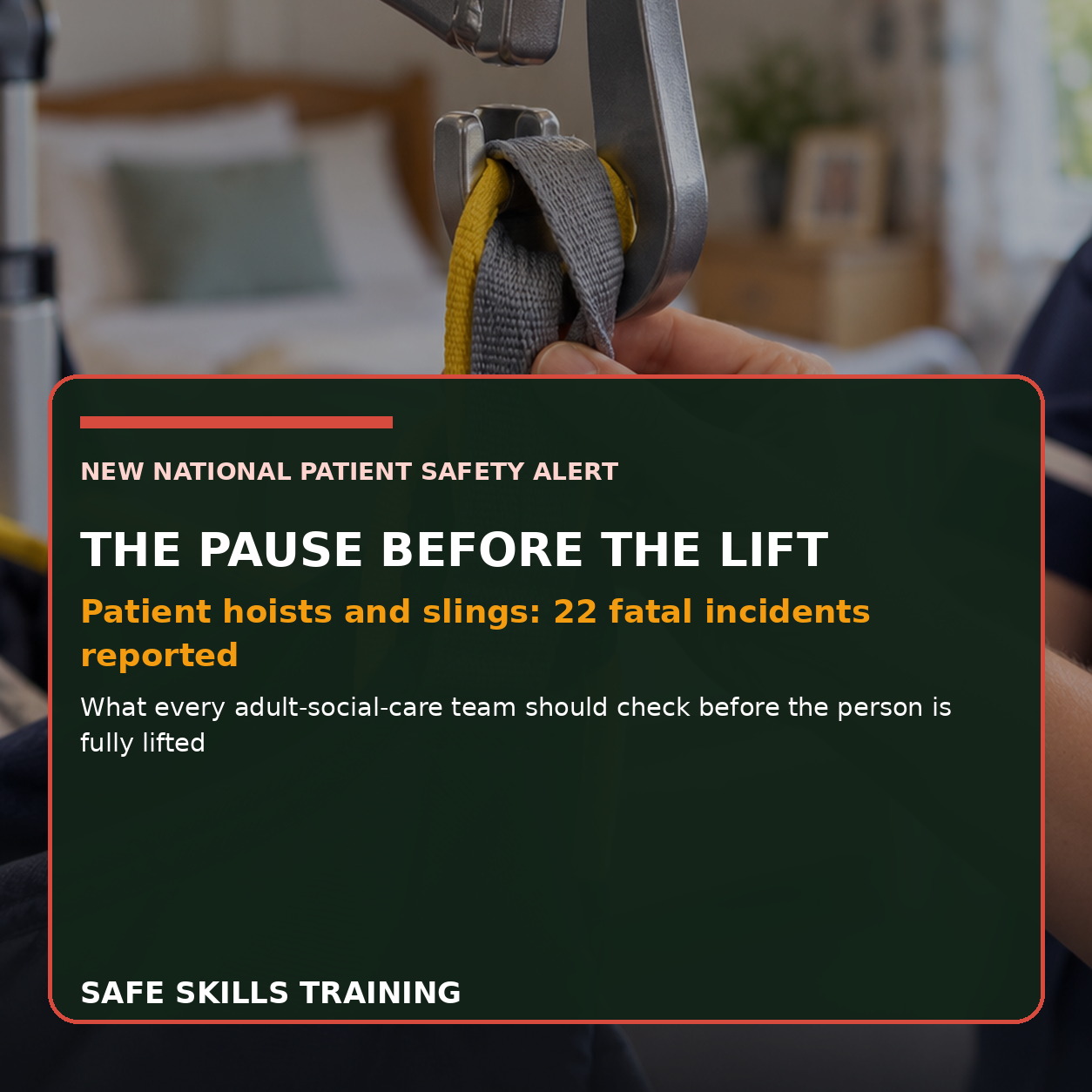
Before the lift: the new patient-hoist safety alert every care service should know
Patient hoists allow people with reduced mobility to be transferred safely, comfortably and with dignity. However, a hoist does not make a transfer automatically safe.
On 16 September 2026, the Medicines and Healthcare products Regulatory Agency (MHRA) issued a safety-critical National Patient Safety Alert covering patient hoists and slings of every type. It applies across hospitals, care homes, nursing homes, community services and care delivered in people’s own homes.
The alert follows continuing fatal and serious harm when people fall from hoists or slings during transfers and repositioning. Between 1 January 2015 and 31 December 2025, the MHRA received 22 reports of incidents with a fatal outcome—an average of two each year.
This makes the alert particularly important as Back Care Awareness Week begins. Safe moving and handling must protect both the person receiving care and the staff supporting them.
WHAT HAS BEEN GOING WRONG?
The MHRA identified recurring causes of fatal and serious falls:
- worn, damaged, missing or incorrectly assembled load-bearing components
- incompatible hoist-and-sling combinations
- damaged or incorrectly seated sling loops
- ineffective pre-use checks
- inadequate or overdue maintenance, servicing or LOLER examination
- the wrong sling type or size for the person
- insufficient equipment-specific training and competence assessment
- failure to follow the manufacturer’s instructions for use
These incidents are not confined to one manufacturer, model or care setting. Familiarity with a hoist is therefore not a substitute for checking it.
THE NEW PAUSE-AND-CHECK STEP
The alert requires organisations to introduce a standardised pre-use check aligned with the manufacturer’s instructions. It includes one especially important step.
After the hoist begins to take the person’s weight—but before the person is entirely lifted—pause. While the person remains supported, confirm that every sling attachment point is securely fitted and seated correctly.
For loop-type attachments, this pause may reveal a loop that is twisted, placed on the wrong hook or not fully seated. Finding the problem before the person leaves the supporting surface can prevent a fall.
This step should be built into routine practice. It is not an optional extra reserved for unfamiliar equipment.
START WITH THE PERSON’S HANDLING PLAN
Before the transfer, staff should check the current person-specific moving-and-handling assessment and care plan. It should identify:
- the transfer being undertaken
- the correct hoist
- the correct sling type and size
- the required loop or attachment configuration
- any additional safety devices
- the number of staff required
- relevant risks and communication needs
The number of staff needed is determined by a suitable assessment—not by a blanket rule. Some people may safely use equipment with less assistance, while other transfers require two or more trained staff.
Stop and seek reassessment if the plan is absent, unclear, out of date or cannot be followed with the available equipment and staff.
WHEN THE PERSON HAS CHANGED, THE PLAN MAY NEED TO CHANGE
A previously suitable transfer may no longer be safe when the person’s condition changes. The MHRA says the assessment must be repeated when there are changes such as:
- weight
- posture or muscle tone
- pain
- cognition or ability to cooperate
- sitting balance
- ability to participate in the transfer
- tolerance of hoisting
Record and escalate these changes rather than quietly adapting the technique or selecting different equipment without authorisation.
CHECK THE HOIST AND SLING BEFORE EVERY USE
The exact check must follow the manufacturer’s instructions and local procedure. Staff should be able to identify problems including:
- missing or incorrectly assembled parts
- worn or damaged hooks, clips, carabiners or retaining features
- damaged fabric, stitching, loops or fasteners
- unreadable or missing identification
- contamination or deterioration that affects safe use
- unresolved defects or an overdue examination
- batteries, controls, brakes or emergency functions that do not operate as expected
Do not assume another staff member has already checked. A pre-use check belongs to the transfer that is about to happen.
COMPATIBILITY MUST BE CONFIRMED
A sling may appear to fit a hoist without being an approved combination. Different manufacturers use different attachment systems, dimensions and safety features.
Compatibility should be confirmed from the manufacturer’s instructions. The new alert also requires organisations to maintain an accessible local register of approved combinations.
Where compatibility cannot be confirmed through the instructions, use must be supported by a documented risk assessment and technical evidence from an appropriately qualified person. Front-line staff should not decide that an unverified combination is safe simply because the attachment appears to connect.
IF SOMETHING IS WRONG: STOP
If a component is missing, worn, damaged or incorrectly assembled:
- do not continue the transfer
- keep or return the person to a safely supported position
- remove the equipment from service
- clearly identify it as not to be used
- report the defect through the organisation’s agreed route
- arrange suitable alternative equipment and support
- record any incident or near miss
Do not tie knots, change the planned loop arrangement, substitute an unapproved sling or improvise a repair.
PRE-USE CHECKS DO NOT REPLACE LOLER EXAMINATIONS
Pre-use checking, routine maintenance, servicing and statutory thorough examination are different safeguards.
HSE guidance states that lifting equipment used to lift people must be thoroughly examined by a competent person at intervals not exceeding six months. Hoists must also be maintained and serviced in accordance with the manufacturer’s instructions. Slings require their own inspection and replacement arrangements.
The MHRA alert instructs services to remove hoists from use where examinations are overdue or defects remain unresolved. Records must be current and must cover equipment supplied in community settings as well as equipment kept at a main premises.
TRAINING MUST MATCH THE EQUIPMENT
Generic moving-and-handling training is not enough if staff cannot safely use the hoists and slings present in their service.
Training and competence assessment should cover:
- the equipment types staff actually use
- the manufacturer’s instructions
- correct sling fitting and attachment
- pre-use and pause-and-check procedures
- recognising unsafe equipment states
- stopping and escalating safely
- reporting incidents and near misses
Staff should say when they have not been trained or assessed as competent with a particular device. Proceeding because the transfer is urgent or the service is short-staffed can place both the person and staff at risk.
COMMUNICATION AND DIGNITY STILL MATTER
Safe hoisting is not only an equipment procedure. Explain what will happen, obtain consent, protect privacy, check comfort and encourage the person to participate as far as they safely can.
Watch for pain, fear, sliding, changes in posture or distress throughout the transfer. Stop if the person or equipment is not responding as expected.
An across-the-board “no lifting” approach can unnecessarily restrict independence. The goal is a person-centred assessment that enables safe movement while protecting everyone involved.
AFTER AN INCIDENT OR NEAR MISS
Make the person safe and obtain appropriate clinical assessment after any fall, sudden movement, equipment failure or suspected injury. Follow the service’s incident, safeguarding and escalation procedures.
Problems involving a medical device can also be reported to the MHRA through the Yellow Card scheme. Near misses matter: they may expose a defect or unsafe system before somebody is harmed.
THE FIVE-STEP PRACTICAL MESSAGE
Before every hoist transfer:
- PLAN — Check the person, transfer, handling plan, trained staff and specified equipment.
- INSPECT — Check the hoist, sling and every critical attachment.
- CONNECT — Fit the sling exactly as assessed and instructed.
- TAKE THE WEIGHT — Raise only until the sling becomes taut and partially supports the person.
- PAUSE AND CHECK — Confirm every attachment is secure before fully lifting.
If anything is wrong, do not continue.
Safe Skills Training provides practical moving-and-handling, clinical-skills, first-aid and patient-safety training for adult-social-care teams. To discuss training for your organisation, visit www.safeskillstraining.com.
GUIDANCE AND SOURCES
MHRA: National Patient Safety Alert—patient hoists and slings, risk of death and serious harm from falls
https://www.gov.uk/drug-device-alerts/national-patient-safety-alert-patient-hoists-and-slings-all-types-risk-of-death-and-serious-harm-from-falls-natpsa-slash-2026-slash-005-slash-mhra
MHRA: Steps to prevent avoidable harm from patient hoists
https://www.gov.uk/government/news/mhra-sets-out-steps-to-prevent-avoidable-harm-from-patient-hoists
HSE: Moving and handling equipment in health and social care
https://www.hse.gov.uk/healthservices/moving-handling/moving-handling-equipment.htm
HSE: Managing the risks of moving and handling
https://www.hse.gov.uk/healthservices/moving-handling/manage-the-risk.htm
CQC: Learning from safety incidents—falls from improper use of equipment
https://www.cqc.org.uk/guidance-regulation/adult-social-care/learning-safety-incidents/issue-1-falls-improper-use-equipment
BackCare: Back Care Awareness Week 2026
https://backcare.org.uk/news/back-care-awareness-week-2026-5th-to-10th-october/